
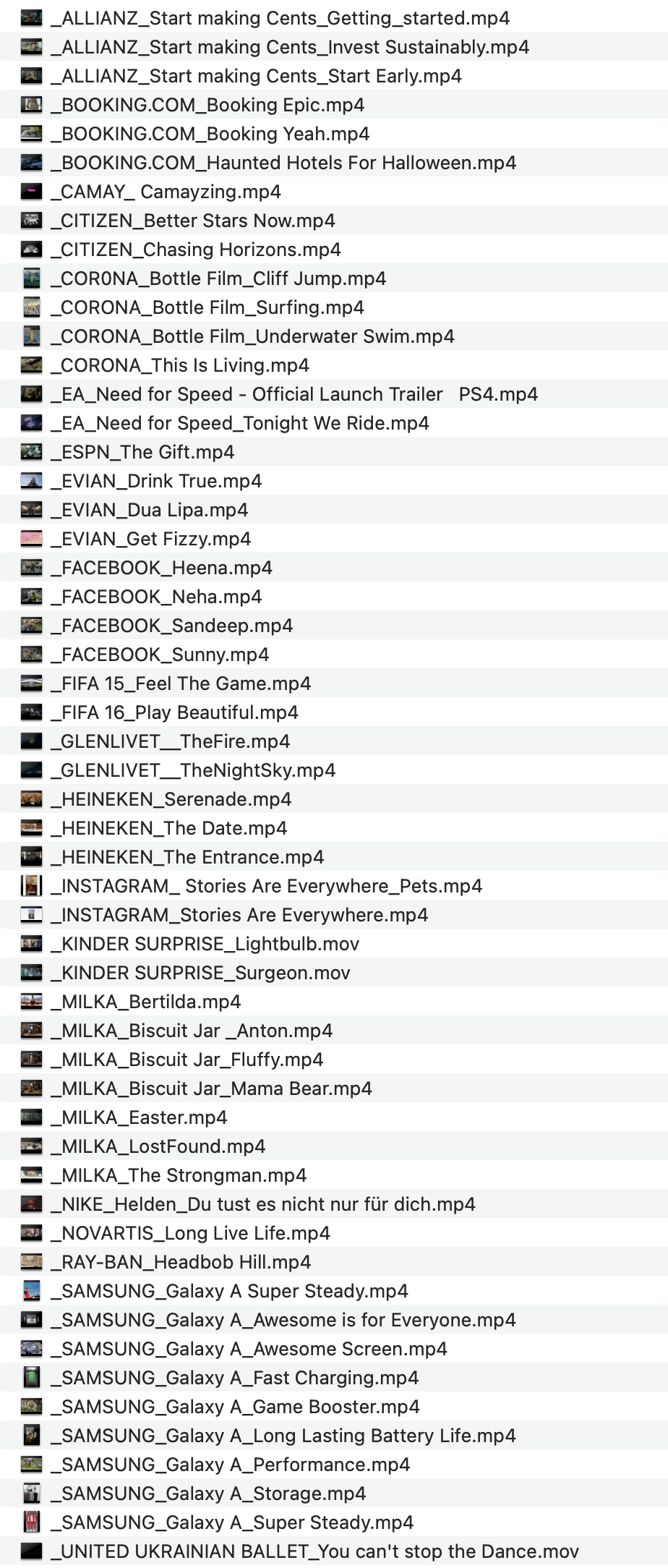
folder: work_my w+k portfolio-2009-2023
This began as housekeeping. I'd set aside a morning to tidy the dumpster fire of folders on my desktop and that I’d been putting off for months. Then I opened one I hadn't looked at in ages: the (incomplete) archive of work we made during my fourteen years as Chief Strategy Officer at Wieden+Kennedy Amsterdam. I had no archive of the previous two and a bit decades, but a question formed in my mind: how does being an agency-side strategist equip one for brand strategy, as opposed to strategy that’s pointed at communications solutions ?
There has been some good conversation on the heels of WARC’s recently published Future of Strategy survey. The most striking finding was that 83% of agency-side strategists expect their remit to increasingly involve “shaping business strategy, not just communications”. I’m all for agency strategists expanding their remit and value, but (respectfully) they might want to begin by reflecting on the distinction between business strategy and upstream brand strategy. Unless they’re keen to get involved in things like debt covenants and transfer pricing. Then again this might simply have been a matter of the options that responders were presented with, or the coding of their answers.
But tidying up my archive did make me reflect that working on the agency side of things as a strategist comes with its gifts. Gifts worth taking on the swim upstream.
What agency life teaches
You learn that a strategy, to be worth the name and create value, has to make its way out into the world and into somebody's life. That journey depends on a whole web of partners and experts, and the strategy has to be intelligible and usable by every one of them.
You also learn under the scrutiny of creative people. A good creative team will find the vague word in a brief within a second and ask what it actually means. If you can't answer, the strategy was decoration, and they’ll kick the bullshit right out of your mouth. You learn that words matter. A strategy expressed poorly or imprecisely will fail to convince or galvanise. As Stephen Bungay writes in The Art of Action, “Understanding gets compliance. Only belief gets commitment.”
Strategists learn that conversation with the client organisation has to be matched by direct conversation with the people on the other side: the consumers the work is meant to reach and move. Or at least they should. Most advertising agencies and their strategy departments have become completely de-skilled in the art of qualitative research. Many now seem to think vox pops count.
Agency work goes out into the world and is encountered by people who owe it nothing, and have never read the positioning. Over decades you develop an instinct for the gap between what a company says it is and what people will believe of it.
You learn that while it is not everything, the expression of a brand is not a trivial part. Having worked across a diversity of categories, audiences, and problems, strategists (if they’re paying attention) acquire what I can only call taste. By which I do not mean the unaccountable subjective preference that some insist on confusing it for, but the ability to make finely-tuned, informed judgments about quality.
Working across categories and audiences teaches more than taste. It gives strategists a store of analogies to draw upon. A problem in financial services may already have been solved in beer, and a retailer’s challenge may echo something you’ve seen in a telco. While business leaders tend to benchmark within their category, the agency strategist’s range is a source of options that the category often can’t see.
You learn that the work isn't finished when the thinking is done and the document or presentation has been shipped. Strategists learn (again, if they’re paying attention) that this is only the beginning. You learn that strategy is a verb, not a noun. That you don’t have a strategy. You do a strategy.
Being an agency-side strategist gives you fluency in culture both fast and slow (even though so much of the agency world sprays it about with so little thought or precision). Business has always found this hard. My old partner in crime Grant McCracken once observed that the business school “is resistant to taking popular culture seriously”. In an interview with Henry Jenkins, he put the stakes plainly: “Culture is increasingly various and changeable. Corporations are increasingly complex and changeable. To find the fit between them takes an exquisite knowledge of both.” Good agency strategists spend their working lives looking beyond category boundaries to understand the broader surrounding contexts that influence people’s needs, wants, aspirations and investigating that fit.
Most agency work never runs. Ideas die in internal reviews, in client feedback sessions, in research, in the conversation with the CEO that the agency wasn’t invited to… The strategists who last learn to separate their judgement from ego or attachment, to tell a bad idea from a good one one that lost, and to come back with something better.
Upstream work needs new skills, and a good serving of unlearning. Still, the strategists who make the move best will be the ones who remember what the agency side taught them, and bring it with them.
Outside the frame
All that said, agency life can trap a strategist inside communications, only ever seeing brand as what the company says, because after all that's what the agency is paid to make.
What lies outside that frame is precisely why I left agency life. Out here, strategy is no longer treated as a precursor to advertising, or as merely its salesperson and ‘setup’ writer. You become an advisor to an organisation. The emotional and political complexity you work inside scales very quickly. Hate feedback? You ain’t seen nothing yet.
You also stop being the expert. Agency-side, you are expected to know communications — at least that’s the theory. But once the work promises to shape an entire organisation, you are working alongside internal functional experts, many of them formidable. Nobody expects you to ride to the rescue on a strategic white horse, and you don't own the solution. You shape it with the client. What you owe them is diagnosis, truth, counsel, options and a framework that helps them choose.
The other lesson is, to my mind, more urgent. As I have argued many times, a brand is made by what a company does as much as by what it says, and it amounts to more than the residue of promises and ad spend. Agency strategists are trained to work on the saying. Advisory work asks you to follow brand into decisions about pricing, product, service, internal culture… and to treat each of them as brand work.
That is increasingly how I now spend my time: helping leaders make sense of what they already know but haven’t yet named or faced, and translating belief into a brand logic that shapes choices, priorities and actions. And yes, communications.
The bedrock
The grind completed and the folder now organised, I reflect that both agency and advisory work teach the same ancient lesson: humility is the bedrock of service.
If you’re swimming upstream, take what travels from agency life and leave the rest on the bank.
martin@emdub.co