
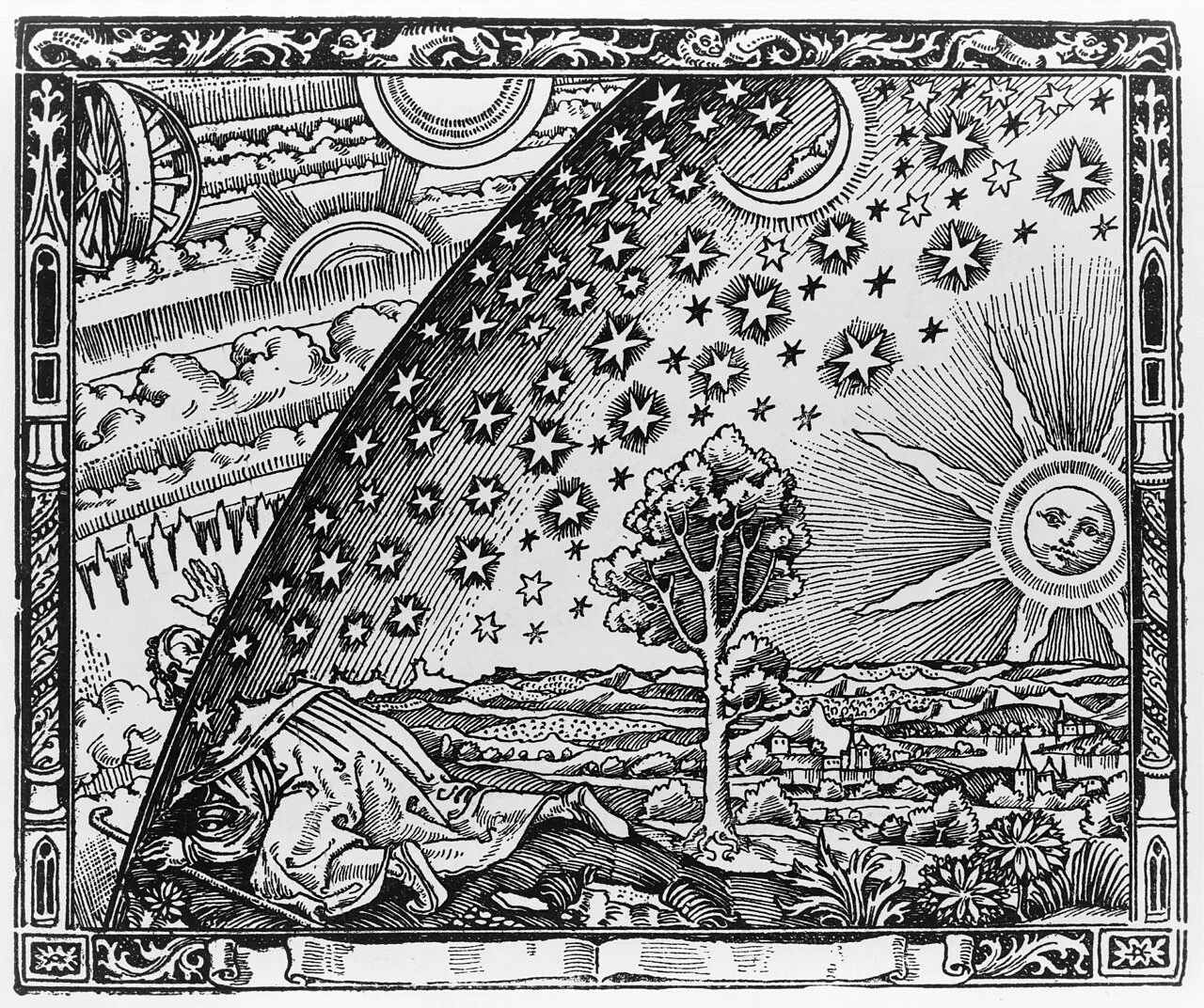
Flammarion engraving, artist unknown. From Camille Flammarion, L’atmosphère: météorologie populaire (Paris, 1888)
Every organisation carries two stories. One it tells the world, in its advertising, its annual report and its careers page. The other it tells itself, in corridors and late meetings and in the reasons given for not doing things. The second story does more work, deciding what feels possible, and which ideas die before anyone ever actually writes them down.
Much of it works the way myth works in anthropology: a story, true or not, that explains the world to the people inside it and is rarely examined. Some of these stories are founding legends, the garage, the first customer, the rule the founder broke. Some are old scars. A team stays cautious about pricing because of a launch that went wrong eleven years ago, though nobody now in the organisation was there. Some are inherited taboos or ways of working. Some are identities that have expired. I have sat with brands that still described themselves as challengers a decade after they became the thing they were challenging.
The stories a company tells itself do not always begin as stories. They begin as one decision: a meeting, a case, a call made under pressure. Then the next decision has to protect the first, and the one after that has to protect both. operate in the background. Decisions stack.
Assumptions stack too. They operate in background, unnoticed, unquestioned and unchecked. Now take that assumption and add another and another and another. Stack them. Let each reinforce the next, protect the one below, and a self-reinforcing edifice of “how things are done” or “how things work” gets built.
On their own, stories and assumptions are harmless. Every organisation runs on them and arguably could not function without them. The trouble starts when they go unexamined; when nobody can say where a belief or assumptiom came from, whether it still holds, or who would be allowed to question it.
***
The usual way to examine a company’s story is the workshop, and while it has its other uses, it is badly built for the job. It favours the rational and the articulate, and its agenda is built to end in agreement. Corporate language does the rest. It is designed to be safe, and safety means nobody says what they actually feel. Leaders talk about headwinds, priorities and optimisation, and the doubts, anxieties or fears underneath go unnamed.
These are not the only things left unsaid. Leadership teams can also carry divides that go unnamed or unresolved: between generations who learned the business in different eras, or between people who hold different beliefs about what the company is for and what its growth philosophy should be.
So the real fault lines stay buried. Leaders learn to live with the conflicts, and the arguments carry on in more private channels. When one of them does surface in a workshop, it is treated as a disruption to the process. And a workshop that fails to land on alignment is invariably judged a failure, which teaches everyone in the room to produce alignment whether or not it exists. An unnamed fear or divide can’t be argued with, so it wins by default.
A while back I suggested to a client that we assemble its executive team for something different. I began in qualitative research, where I was trained to surface the truths people hold and don’t say, to make conflict and disagreement safe instead of encouraging superficial alignment, to challenge autopilot pre-fab answers — and to listen. It would be like a focus group, I explained. Think of it, I said partly in jest, as a “strategic Ayahuasca” session. Not a brainstorm, but a structured introspection: a closed session in which leaders name the doubts that hold them back, the stories they live inside, the frictions that have been papered over, the divides they have learned to work around, and the possibilities they have forgotten to voice or believe.
The truth did emerge. To stay competitive, the company now had to run at two speeds, but the story it told itself had room for only one. The work that followed gave it a more coherent account of itself, one that could hold both. And the name stuck.
The session worked because it was built for depth, participants felt free to speak openly, and consensus was not its aim. The conversation moved through identity, doubt and ambition, in that order. It surfaced the beliefs and instincts that gave the organisation its real strength. It also surfaced the patterns of self-deception that were sabotaging it. I think of these as its “angels and its demons”, and a company needs to know both by name, which is why that’s what I call the debrief.
The work is deeply, necessarily human. It happens as much in what goes unsaid as in what is said: the pause before an answer, the glance towards the chief executive, the colleague who agrees too quickly, the silence after a word that touched a nerve. The moderator has to hold the space, read all of it, spot the quiet sceptic with their arms crossed and invite them to voice what they’re withholding, detect the conflict that’s under the surface, decide in the moment whether to press or to wait, give every voice the same weight regardless of rank, and make it safe for the second most powerful person in the room to contradict the first… No synthetic moderator comes close to that, and I doubt one will soon.
As for synthetic respondents that we hear so much about now, they are built to stand in for a population, and they return its average. This process has no use for an average. It depends on particular people: this chief executive, this finance director, this regional head who has not voiced her frustrations. The stories and doubts in question belong to them. A model can approximate a segment, but it can’t reproduce the specific people who run a company, and in this work those people and their history are the material.
***
None of this is for every company. Some leadership teams are tight and coherent, already share an honest account of themselves, and would gain little from a session spent digging. The process earns its place at an inflection point: a change of leadership, a new competitor, a technology that redraws the category, a growth plan the current story can’t carry. At those moments there will be different views of the way forward, and there should be — the point is to get them said in the room.
Every company will have to answer what it is for, and machines are a forcing function that demands an answer. If a model cannot clearly summarise what your brand stands for, what makes it different and why someone should choose it, the issue is very probably not the model.
The question of what a company is for can’t be answered honestly while the old stories, assumptions and divides go unexamined, and only the people who hold them can do the examining.