
Feet In
I was going to write about Tom Cruise. I was going to do that despite the sheer exhausting keenness of him, the relentless unironic intensity, and the way he runs - always flat out, always slightly too committed for the scene - as though someone told him once that running was the truest form of sincerity and he has never stopped testing the theory. I thought I’d be writing about his superpower and how his work continues the legacy of Buster Keaton. But in nerding out for this piece I came to understand that he’s just a very good simulacrum of Keaton. And that having spent thirty years talking about authenticity and brand trust and audience connection, someone should have stopped me and said: there is a man, dead since 1966, who solved this already, in silence. You should go watch him before you open your mouth again. I'm opening my mouth again. But at least now I've watched him.
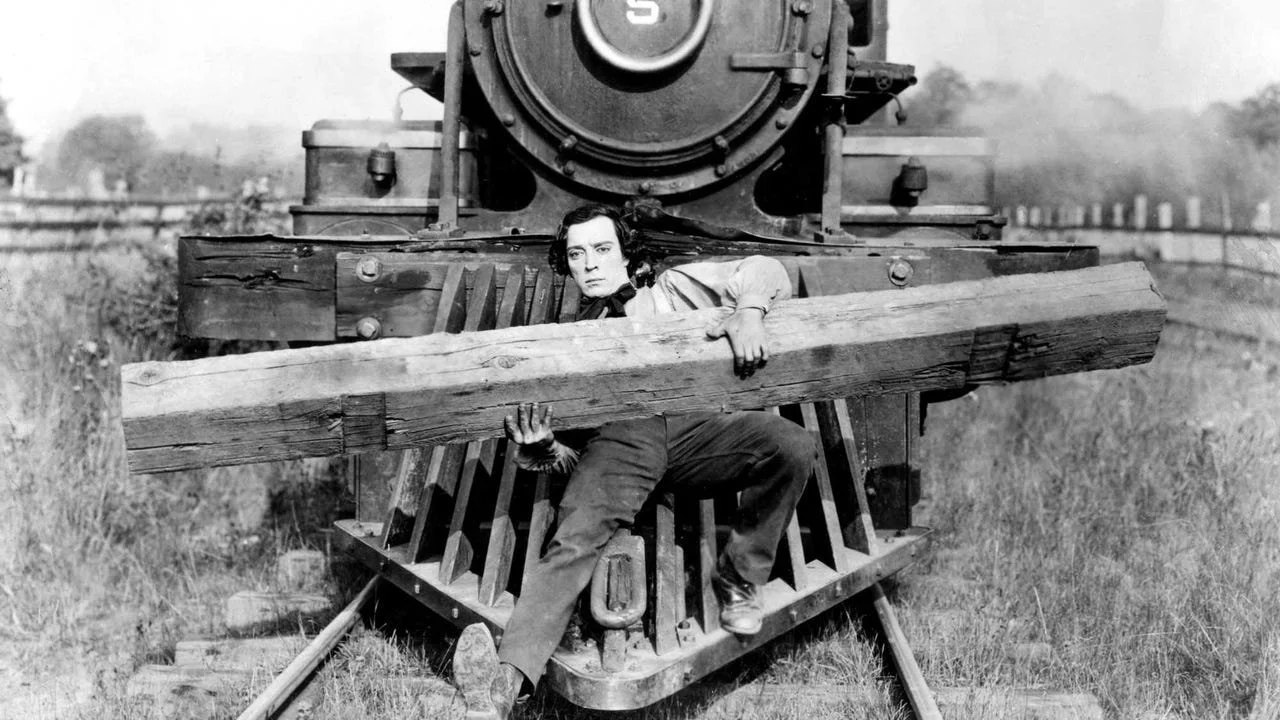
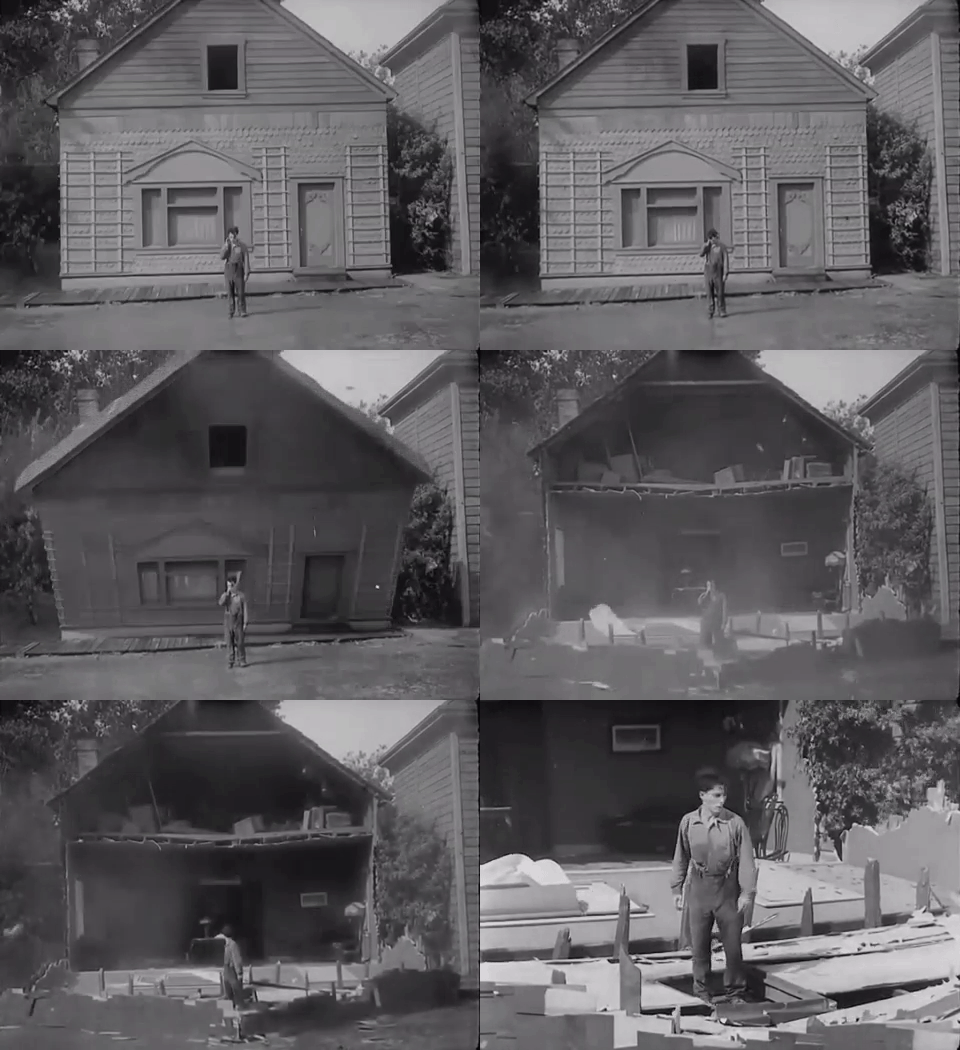
Keaton did his own stunts. There was the collapsing house façade in Steamboat Bill, Jr. (1928), where a two-ton wall fell around him while the window frame cleared his body by two inches on each side - the crew either walked off set or prayed. In The General (1926) he rode the cowcatcher of a locomotive at full speed with no one at the controls with a railway tie in his arms, using it to knock a second tie clear of the tracks ahead of him. In Seven Chances (1925), the boulder avalanche used papier-mâché rocks - 150 of them, some weighing 400 pounds. One knocked him twenty feet into the air. When he staggered up and kept running, that part was unscripted. He risked serious injury and often didn't know how badly he was hurt until later. He broke his neck during the water tower sequence in Sherlock Jr. (1924), the back of his head striking a steel rail, and didn't discover it for eleven years - having continued performing without complaint throughout.
And then one day - having spent his career doing it himself - he found himself being told by MGM to use a stunt double during his time at the studio in the early 1930s. He objection was simple and unsparing: “Stuntmen don’t get laughs.” Packed into that wasn’t a dismissal of stunt performers but a precisely pointed understanding of how physical comedy actually worked.
Keaton had come up through vaudeville, where his father would literally throw him across the stage as part of the act. By the time he was three years old, they were billed as "The Roughest Act That Was Ever in the History of the Stage". But for all the physicality of his performance, Keaton understood that the laugh doesn’t come from the stunt. It comes from the character experiencing the stunt. When Keaton stands there - impassive, small, stubborn - as a building falls around him, we laugh because we recognise some part of ourselves in the predicament. Because the person navigating the disaster is the same person we’ve been watching for the last hour, continuous and present and unmistakably themselves.
For Keaton the stunt was never the point. The point was the integrity of the emotional contract between the character and the audience that underpins all his work. That contract rested on three things:
Continuity of character was the first and most fundamental. The same face, the same body, the same impassive presence confronting chaos. Keaton was specific about this to the point of technical insistence: he preferred long takes, kept the action in a single shot, and refused close-ups. “All comedians want their feet in,” he said. The long take, full figure, in one shot, is the filmmaker saying: I am not directing your eye away from anything, there is nothing here I need to hide or concoct.
Authenticity of risk was the second. The audience had to feel the danger is real. The greater the veracity of the risk, the greater the tension which, when released, became laughter. Manufacture the risk, sanitise it, route it through a double, and the tension would evaporate and the laughter not come. The house in Steamboat Bill, Jr. weighed two tons. "They gave me a spot on the floor where the window would pass over me” he later said. “I trusted the carpenters." Two tons and a chalk mark on the floor. The audience believed the danger was real because it was.
And the third was creating the space for real identification to happen. We don’t laugh at an anonymous body performing a trick. We laugh at someone we’ve got to know who is suddenly and completely at the mercy of forces larger than themselves. “All my life I have been happiest” he later wrote in his autobiography, “when the folks watching me said to each other, 'Look at the poor dope, wilya?'" His ideal audience response wasn’t admiration or amazement, but recognition and empathy. Look at the poor dope. The audience seeing themselves in the predicament.
Keaton’s superpower wasn’t the physical courage - although that was extraordinary - it was his absolute, technically insistent, never-negotiated continuity of character. A character that made the audience do the work of feeling what his face refused to show.
In contrast to Chaplin who always lets us see the effort, the pathos, the yearning, Keaton removed all trace of easy emotional legibility. In his expressionless face was the suggestion that feeling and chaos had been so thoroughly processed that the external world had simply stopped being surprising (very 2026, that). Buildings fall, cyclones strike, trains collide, entire police forces give chase, armies pursue him, boulders roll, ships founder, feuding families want him dead. But the face never moves, and so instead of being spoon-fed visible and obvious emotion, the audience is trusted to do the emotional labour themselves - to infer an entire inner life from what is the absence of any external signal. Keaton understood that intimacy we’ve constructed ourselves always feels truer than the prepackaged intimacy we’re handed on a plate.
Robert Pirsig, writing about something else entirely - or appearing to - named what the audience was responding to, fifty years later, in his book Zen and the Art of Motorcycle Maintenance:
“It is the little, pathetic attempts at Quality that kill. The plaster false fireplace in the apartment, shaped and waiting to contain a flame that can never exist. Or the hedge in front of the apartment building with a few square feet of grass behind it. A few square feet of grass, after Montana. If they just left out the hedge and grass it would be all right. Now it serves only to draw attention to what has been lost. Along the streets that lead away from the apartment he can never see anything through the concrete and brick and neon but he knows that buried within it are grotesque, twisted souls forever trying the manners that will convince themselves they possess Quality, learning strange poses of style and glamour vended by dream magazines and other mass media, and paid for by the vendors of substance. He thinks of them at night alone with their advertised glamorous shoes and stockings and underclothes off, staring through the sooty windows at the grotesque shells revealed beyond them, when the poses weaken and the truth creeps in, the only truth that exists here, crying to heaven, God, there is nothing here but dead neon and cement and brick.”
It seems to me that when Pirsig talks about Quality he’s not talking about excellence in the conventional sense, but rather a kind of inner alignment- a repudiation of half-hearted performance, hollow gesture, empty mimicry, and behaviour that cannot be convincingly sustained. In his commitment to the audience really believing that his character was completely at the mercy of forces larger than himself, Keaton understood what Quality demanded.
Which brings me, briefly, to Tom Cruise. Sure, he jumps out of planes, pilots helicopters, holds his breath for six minutes underwater. He is, by any reasonable standard, extraordinarily committed. When asked at Cannes why he does his own stunts, he replied: “No one asked Gene Kelly, ‘Why do you do your own dancing?’” Which is Cruise being dismissive in the most brilliantly clarifying possible way. Physical performance is the job. But the fact of the matter is that Cruise has to work very hard to prove what Keaton never had to prove at all. The behind-the-scenes footage, the verified jump counts, the director interviews establishing his proximity to actual danger - when an entire industry has spent decades learning to fake it, Cruise needs the full apparatus of trust-building infrastructure just to be believed. And we're kidding ourselves if we think we can tell the difference without it. For Keaton, however, the performance and the proof were the same thing, in the same frame, in one take, feet in.
How many brands and businesses I wonder, perform the promise rather than keep it, satisfying themelves instead with sending a double to the hard moment and hoping the audience won't notice the substitution? The airline that sells you a experience and delivers a call centre populated by underpaid contractors reading from a script at 11pm when your flight has been cancelled and all you need is a hotel. The hotel that puts "passion for hospitality" on its walls and a QR code on the table where a waiter used to be because they're "short-staffed tonight." The telco company that promises to make life simpler and whose customer service is a chatbot maze that would make Kafka proud. The bank that's all about being on your side and then restructures its branch network into oblivion. The food brand that tells you about its sustainable farming practices - knowing that there is no legal definition of "sustainable" as a marketing term.
Keaton never sent anyone in his place. In the pursuit of integrity, trust, and belief he understood there is no version of that where you get to be somewhere else. You are in the frame, feet in - or you have betrayed something. There is no third option. Keaton's formulation was characteristically simple: "For a real effect, and to convince people it's on the level, do it on the level." He meant it as craft advice. It applies rather more broadly than he intended.
***
Martin Weigel is a brand strategist, former Chief Strategy Officer at Wieden+Kennedy Amsterdam, and founder of EMDUB. He helps companies find their superpower - and turn it into action.