The Book the Writing Made
A few years ago — this book has gone through many incarnations over many, many years — I took a call from the senior commissioning editor at Penguin while sitting in my mother's garden, surrounded by butterflies and the buzzing of bees. The feedback was basically to make it more like a generic business book — case studies, top tips, the usual. I understood. That is what the system needs it to be. But I had waited too long and come too far to compromise. I chose to self-publish — so that this book could be, for better or for worse, exactly what I wanted it to be, not what the system demanded.
Read More
Why everybody gets to have an opinion
My former chief creative officers at Wieden+Kennedy Amsterdam used to say it directly, about the work: “You do not have the right not to have an opinion.” They weren’t talking about taste. They were talking about responsibility. If the work goes out into the world and does something — to people, to a brand, to a culture — then everyone in the room owns a share of that. And gets to have an opinion.
Read More
On Editing, Strategy, and the Art (and power) of Useful Distance
An editor does not write the book. A consultant does not run the company. But what they both provide is the rigour of asking - what are you actually trying to do, and are you doing it? In this sense, the best editors and the best strategic consultants hold the client to the best version of themselves. The goal is never to make the book sound like the editor, or the brand sound like the consultant. It is to make each sound like the truest version of itself.
Read More
On having Skin in the game
The agency side of the table talks about ownership - clients to feel ownership of the work, how to bring them on the journey, how to make the creative decision feel like theirs. What we are less aware of (or honest about) is what ownership actually requires. It requires skin in the game. Real exposure to the consequences of the choice. And most agency practitioners operate without it. We make the case. We do the craft. We manage the process. The client bears the cost and the risk.
Read More
The one thing strategy does not deliver
But an organisation with genuine clarity about who it is, where it is trying to go, and what decisions will get it there is not defenceless against that uncertainty. It is oriented inside it. It knows what signals to watch and which ones to ignore. It knows what a good decision looks like even when the data is ambiguous. It knows when to hold its course and when the signals that matter are strong enough to warrant a change of direction. It can move faster, waste less, and hold its shape under pressure in ways that organisations chasing certainty - commissioning the next round of research, waiting for the model to tell them what to do - simply cannot.
That is the job. It was always the job. It is the only honest account of what strategy can actually deliver. The work is not to make the uncertainty disappear. It never does.
Read More
Brand Infrastructure: The Challenge and the Opportunity
That upstream narrative work cannot always be done from the outside alone, nor can it always be successfully delegated entirely within. Clarity and practical application often requires (particularly when conviction and direction have leaked from the organisation) both proximity and distance. But however they accomplish it, the organisations that do the work find that they become more deliberate and more coherent - not just in their communications, but in their decisions, their culture, their product, their conduct under pressure. The organisations that don't find that the activity never quite adds up to anything - and that consumers (and their own people) can feel the gap between the promise and the delivery. The infrastructure either gets built or it doesn't. The difference accumulates in both directions.
In the end, organisations don’t get the brand they advertise. They get the brand their decisions build. And those decisions either run on narrative infrastructure - or they drift.
Read More
No really, Who are you?
AI removes the last remaining cover. In a world where everyone has access to the same generative capabilities, at the same cost, at the same speed, the only thing that differentiates one organisation’s output from another’s is the quality and specificity of the self-knowledge it was built from. If the model cannot clearly summarise what your brand stands for, what makes it different, and why someone should choose it, the issue is very probably not the model. It is usually that the brand itself lacks articulated clarity. So the good news is that AI will force marketers to answer the question it has spent the best part of two decades neglecting - "who are you?". You cannot prompt your way around the identity question, automate your way past it, or ask the machine to serve you an oven-ready answer. “Find out” - Dolly's instruction requires honesty about not merely what you said you believed, but what your decisions reveal you believed; what you could do and are choosing not to; and what you have become versus what you intended to be.
Read More
Releasing The Monster Down There
“Late style arrives when you realise that you are: competent enough to write those things you wanted to write when you were twenty-five; impatient enough to have one more go at going all the way; angry enough not to allow anyone else to persuade you to do something else. At the same time, late style is cold, amused, contemptuous and savage about everyone you have been or ever tried to be. Late style is when the monster down there has finally had enough of you.”
Read More
Feet In
How many brands and businesses I wonder, perform the promise rather than keep it, satisfying themelves instead with sending a double to the hard moment and hoping the audience won't notice the substitution? The airline that sells you a experience and delivers a call centre populated by underpaid contractors reading from a script at 11pm when your flight has been cancelled and all you need is a hotel. The hotel that puts "passion for hospitality" on its walls and a QR code on the table where a waiter used to be because they're "short-staffed tonight." The telco company that promises to make life simpler and whose customer service is a chatbot maze that would make Kafka proud. The bank that's all about being on your side and then restructures its branch network into oblivion. The food brand that tells you about its sustainable farming practices - knowing that there is no legal definition of "sustainable" as a marketing term.
Read More
Strategy, Legibility, and Machines
AI-readability is simply a new stress test for an old discipline: say what you are, mean it, make it legible, and let your decisions prove it. I will never get tired of quoting Dolly Parton – "find out who you are, and do it on purpose ".
Read More
Can Strategy exist without the Slides?
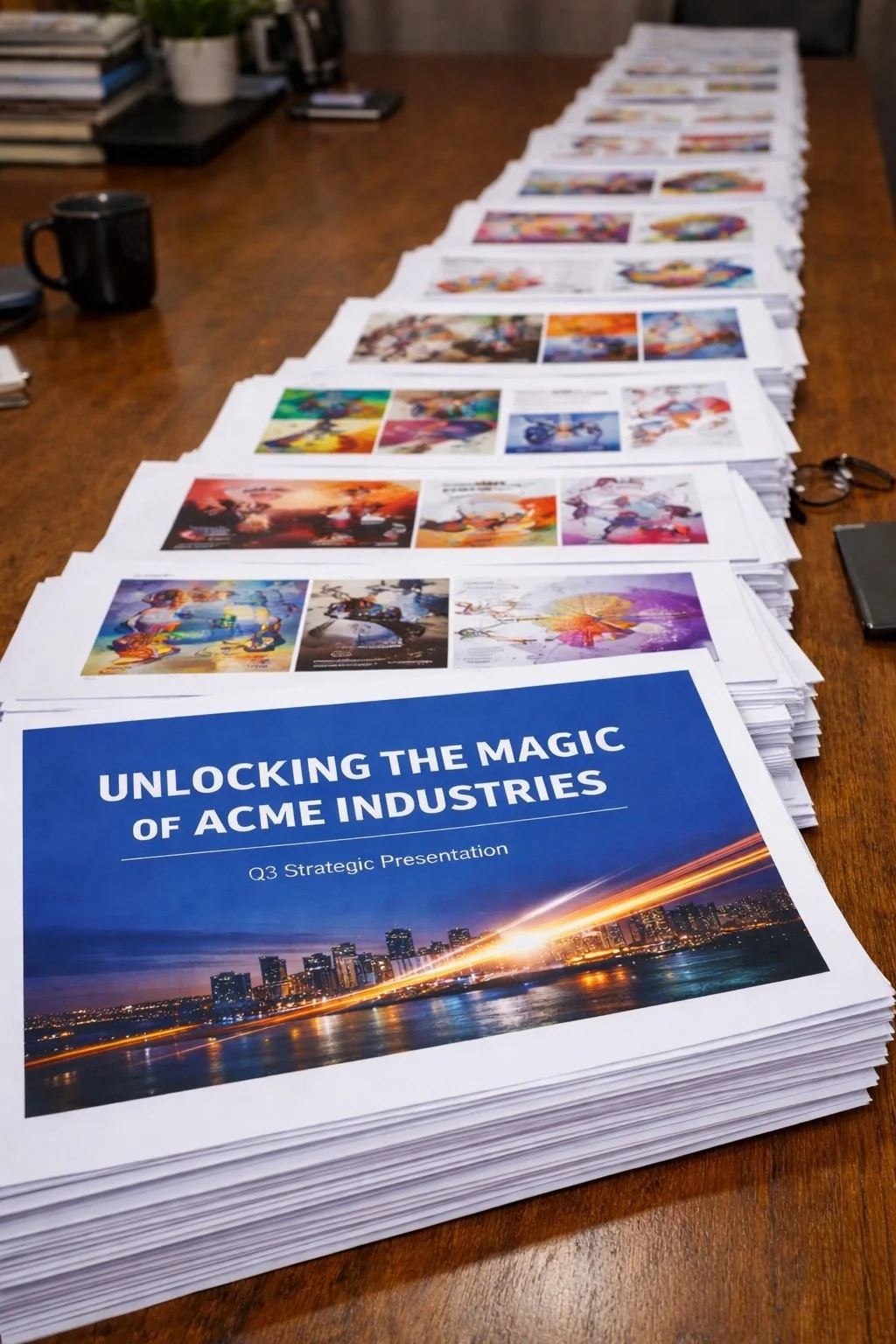
We know that brevity in strategy is not performative minimalism. So why the industrial scale slide-count?
Read More
Stories of conviction: Corona
Like what do you do when your brand has become a prisoner of executional formula and wants accelerate growth with a real long-term brand platform?
That was the challenge facing Corona.
Read More
Stories of conviction: The Glenlivet
Brand problems? I’ve seen a few…
Like what do you do when being a single malt whisky with a deeply authentic, hundred-plus-year-old story of craft and tradition isn’t enough of a reason to buy in an ocean of whisky with deeply authentic, hundred-plus-year-old stories of craft and tradition?
Read More
Stories of Conviction: Milka
Like what do you do when your business and brand has become so addicted to chasing short-term innovation uplifts that it’s allowed its core business to be eroded?
Read More
Stories of conviction: United Ukrainian Ballet.
Like what do you do when a group of refugee ballet dancers in Amsterdam form a dance company and want to use their platform to highlight the horrors unfolding back home, while still selling tickets? Oh, and when it’s not an agency assignment, and the budget is virtually zero?
Read More
Stories of Conviction: Booking.com
Like what do you do when you are disproportionately reliant on paid search and find that your customers are booking accomodation but have no memory that it was through you?
Read More
The false religion of insight
Observation, curiosity, empathy - these are vital. Dieter Rams said "Indifference towards people and the reality in which they live is actually the one and only cardinal sin in design”. His words apply to the development of brands and advertising too. But the idea that ‘insight’ is and must always be the starting point and first hurdle to overcome is deeply flawed. The strategist’s real job isn’t to find truth - it’s to create traction, and create change. Insight may be helpful in that endeavour. But it is not holy.
Read More
Whose side are you on?
There is much that is problematic with the theology of ‘insight’ as presented by the self-appointed members of its Inquisition. But even if one were to reject the various articles and tests of faith they demand and think more simply (heresy!) in terms of useful understanding, I have come to believe that as a way of thinking about our intended audience, it is still not quite enough.
Read More