
On Editing, Strategy, and the Art (and power) of Useful Distance
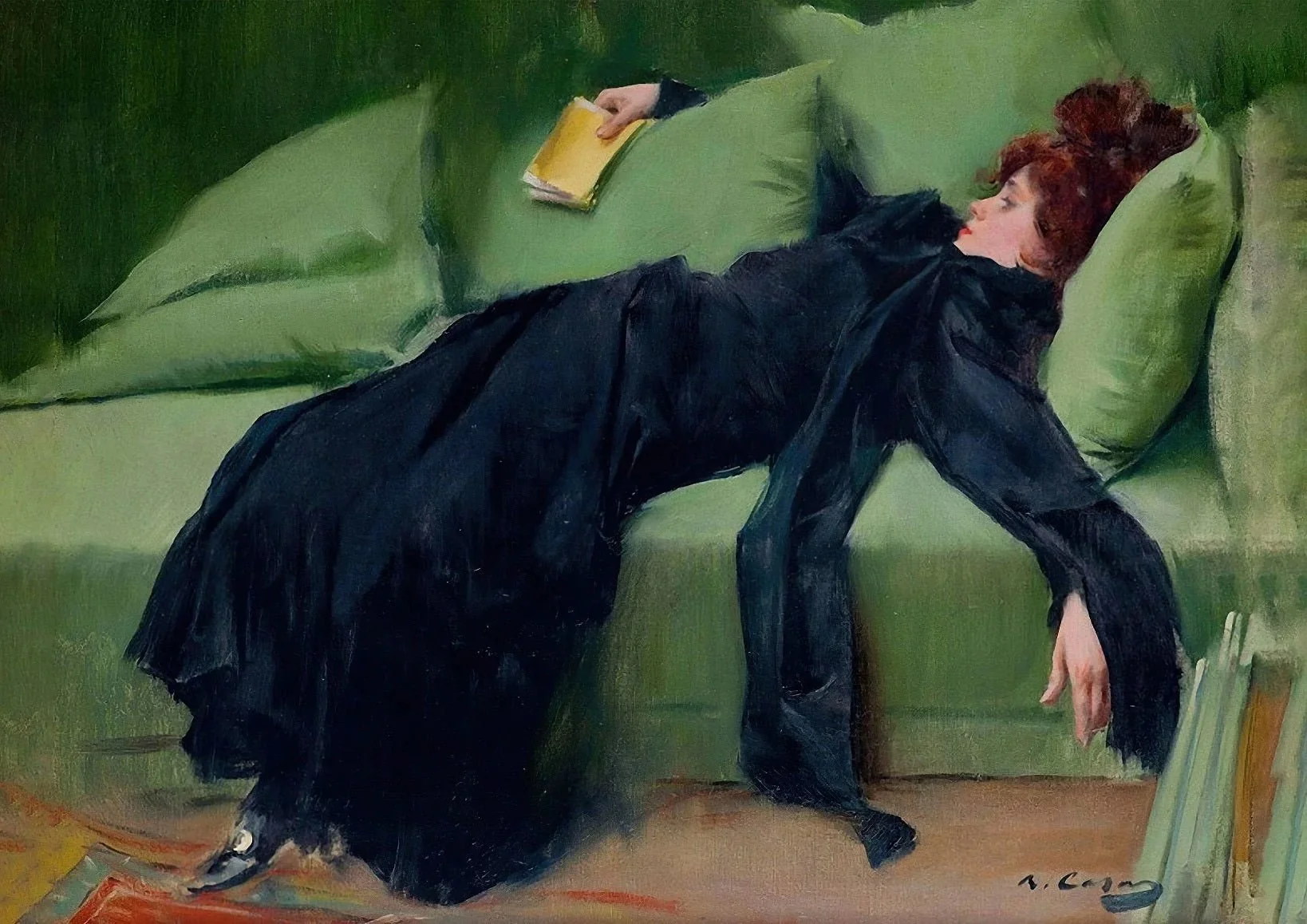
Ramon Casas, Joven decadente, 1899
I've just got off the phone with my editor. What was a manuscript is now off to become a book. Her work is done. Our year of drafts, correspondence, and debate has come to an end. It was a rather bittersweet moment.
It seems so long ago now, but back in 2025, I could no longer see what I had written. I’d written and rewritten the words so many times, and turned the arguments over in my (waking and sleeping) mind so often, that I’d stopped reading what was actually on the page and was just reading what I had intended to put there. I was utterly blind, and had reached what felt like a dead end. I am so very thankful I decided I needed the help of a professional editor, even if at the time I wasn’t really sure how she would actually help.
It turned out to be an education - not just in the value an editor brings, but quite unexpectedly, in what that value reveals about the strategic consultant’s role.
My editor was what I the author could not be - a reader. She read the manuscript without insight into my assumptions, with no background briefing on my intent and motivation, without the private knowledge of what a passage was meant to do even if it wasn’t quite doing it, and without the years (and years) of personal and emotional investment that had been poured into it. She read it cold, as the eventual audience would. And in doing so, she identified something I could not - the gap between my intent and execution.
That gap is, I very quickly learnt, is where the real work of editing happens. A good editor does not simply correct - she interrogates. And interrogated she did - often ruthlessly, without mercy. Why does this chapter open here rather than there? Is this your actual argument, or some just the audience warm-up act before the argument? What is the book actually trying to say, and is it actually saying it? Do you think swearing this much serves your purpose? Is that really the best title for it? Who are you writing this for anyway? These were not just pedantic or technical questions. They were the fundamental questions of clarity, purpose, and coherence that I, too invested in and close to my own material, simply could not ask with the necessary detachment and rigour.
The structural contribution my editor would make was something I had badly underestimated. She helped me find the throughline of the book - the driving idea around which everything else could organise itself. She helped craft a natural progression of sections, pushed back when chapters were just unnecessary or indulgent baggage, or when the sequence of chapters risked getting in the way of clarity or momentum. Robert Gottlieb - who edited Toni Morrison, Joseph Heller, and John le Carré - described editing as "simply the application of the common sense of any good reader." That's what she brought. And it turned out to be everything.
And then there was the sentence level work. Having sweated the words for years and looked upon some of my favourite turns of phrase with I confess, a private glow of self-satisfaction, it was tough to face up to the need for some heartless culling. But a book is not merely an argument but a voice - sustained across hundreds of pages, asking the reader to stay with it. My editor tuned into and channelled that. She noticed when it strayed or faltered, when it lapsed into jargon (or nonsense), or when a sentence that seemed elegant in isolation derailed the flow of a paragraph. But she never tried to write it for me - she just made me write it better. Maxwell Perkins is one of the most celebrated editors in American literary history - the man at Scribner's who discovered Fitzgerald, Hemingway and Thomas Wolfe, shaped their manuscripts, fought their corners, and never once sought the credit. His credo never wavered: “The book belongs to the author.”
What my editor ultimately provided, I discovered, was a kind of rigour. Writing a book is an act of sustained conviction. Or at least it aims to be that. Editing is the discipline that tests whether that conviction actually holds. The two – writing and editing - are inseparable. Whatever judgements are eventually passed on my book, I know it would have been a far, far lesser thing had I chosen to go it alone.
Our work concluded, I have come to appreciate that the best books (N.B. I am not counting mine among them) are always, in some sense, a collaboration between a writer willing to be challenged and an editor willing to do the challenging. That relationship, that dance, is where good books become better ones. The American choreographer Twyla Tharp understands better than many what that dance entails when she writes “all collaborations are love stories”. Mutual respect, shared ambition, give and take, radical honesty, and creation over ego.
***
Looking back on its year-long development, I find myself reflecting on the parallel between the editor and the strategic consultant - both are fundamentally about bringing useful distance to someone too close to their own material.
Just as I had lost the ability to read my own work clearly, organisations lose the ability to see themselves clearly. Familiarity breeds assumption. The way things are done becomes indistinguishable from the way things must be done. A strategic consultant, like an editor, arrives without that accumulated blindness - they read the organisation cold, as an outsider would, and in doing so surface the gap between what the organisation thinks it is and what it actually is – and what the very best version of itself could look like.
Both the editor and the strategist work at multiple levels. An editor works at the level of structure (is the shape and order right?), argument (is this actually what the book is saying?), and sentence (is the voice consistent and clear?). A strategic consultant moves between the equivalent levels - the overall positioning and direction of a business, the coherence of its choices, and the day-to-day manifestation and expression of its brand. The risk in both relationships is that the work devolves to the most visible, most easily correctable level - copy-editing in writing, executional tweaks in brand strategy. The most valuable contribution in both cases happens higher up.
The editor and the strategic consultant also subscribe to a similar loyalty. The editor’s primary loyalty as I have discovered, is not to the author’s comfort (!) but to the reader’s experience. A good strategic consultant holds a similar position - their loyalty is not to the client’s existing convictions but to the organisation’s actual interests and the people it is trying to reach and serve. For both the editor and the strategic consultant that sometimes means saying things the client does not want to hear. The relationship only works if both parties understand this.
And in both cases, the output is a sharper, more coherent version of the other person’s work. An editor does not write the book. A consultant does not run the company. But what they both provide is the rigour of asking - what are you actually trying to do, and are you doing it? In this sense, the best editors and the best strategic consultants hold the client to the best version of themselves. The goal is never to make the book sound like the editor, or the brand sound like the consultant. It is to make each sound like the truest version of itself.
***
Diana Athill (1917–2019) was one of Britain’s most respected literary editors, spending nearly five decades at André Deutsch, the London publishing house she helped found. She edited some of the most celebrated writers of the 20th century - among them V.S. Naipaul, Philip Roth, Norman Mailer, John Updike, and Jean Rhys, whose novel Wide Sargasso Sea she shepherded to publication over nine years of painstaking work. In her memoir Stet, she wrote: “An editor must never expect thanks… We must always remember that we are only midwives - if we want praise for progeny we must give birth to our own.”
Susannah Lear, you might not expect thanks, but you were the best editor. Our collaboration was both a genuine pleasure and an immense education. Thank you.
***
Martin Weigel is a brand strategist, former Chief Strategy Officer at Wieden+Kennedy Amsterdam, and founder of EMDUB. He helps companies find their superpower - and turn it into action.