
You Are Not A Meat Sack - or: The Lost Knowledge Of The Body
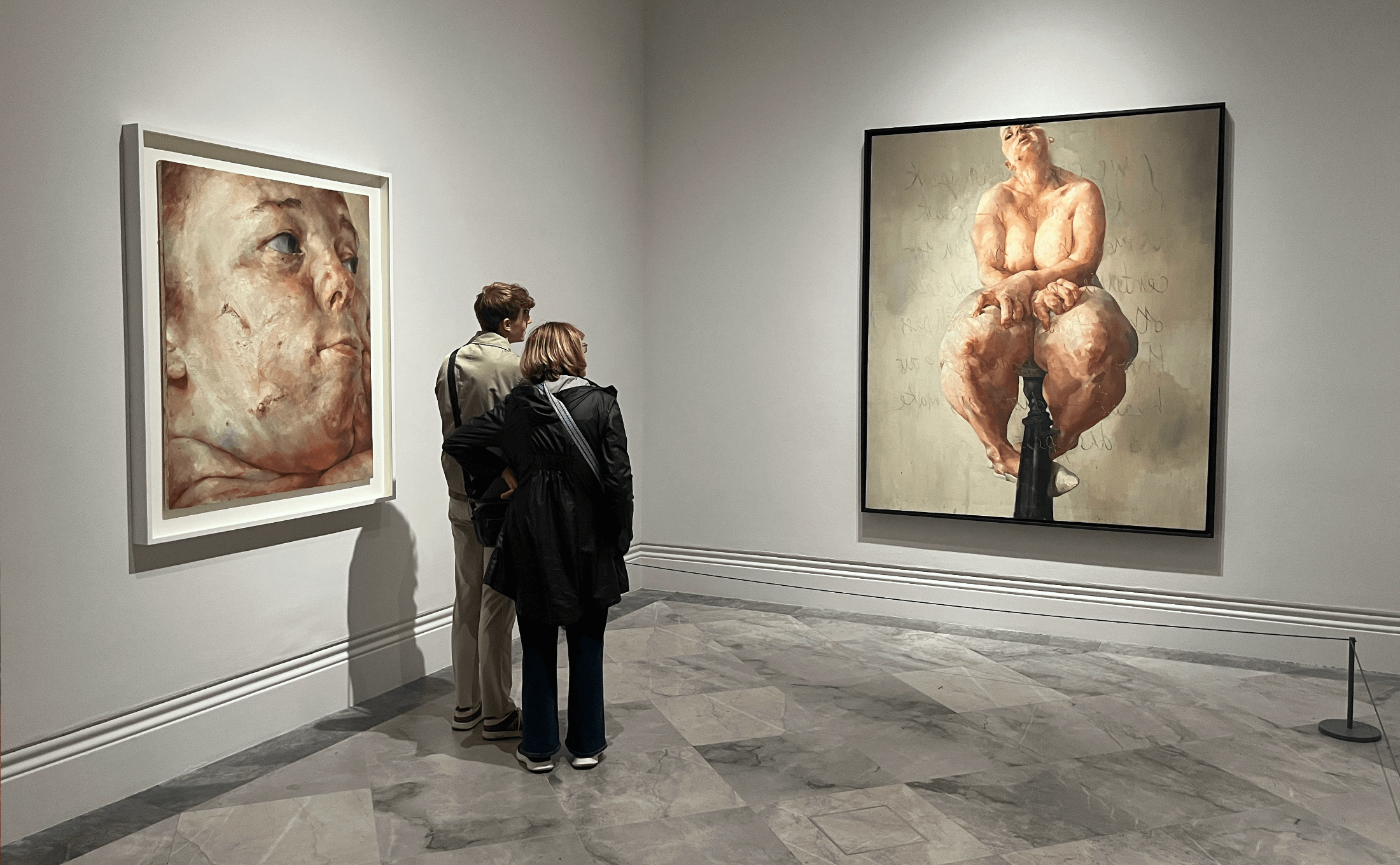
Jenny Saville, Propped (1992)
At some point in the last few years, millions of people began having earnest, extended conversations about the nature of intelligence, the future of knowledge, and what it means to be human - conducted entirely through their fingertips, on glass rectangles, while their bodies sat forgotten in chairs. The WHO, in 2024, estimated that 1.8 billion adults - roughly one in four people on the planet - are now insufficiently physically active. The average person spends 44% of their waking hours looking at a screen. We are, in the most literal sense, losing the habit of having bodies. The irony is so complete it has become invisible. We are debating what minds can do, using bodies we have stopped noticing, in the service of building systems that will have no bodies at all. And nobody finds this strange.
The entire conversation around artificial intelligence is about the mind. About cognition. About intelligence, reasoning, pattern recognition, knowledge, memory. About what the mind does and how machines might do it better, faster, cheaper, at scale, what AI will do to knowledge work, whether machines can truly reason, what it means for a system to understand rather than merely predict, etc.
The prophets and builders of this future are good at gesturing vaguely to the second-order consequences of their technology -"It will not be an entirely positive story," as Sam Altman put it, as if delivering a mandatory legal disclaimer. Daron Acemoglu - MIT professor, 2024 Nobel laureate, co-author of Power and Progress (with Simon Johnson, 2023) - calls out their neglect of the socio-economic ones, arguing that the people building these systems have a financial interest in not examining the distributional consequences honestly.
But there's also the second-order consequence that concerns how we know things - the slow devaluing, in a culture increasingly organised around frictionless intelligence, of the very faculties - bodily, felt, irreducibly physical - that produce the kind of knowing machines, by their very nature, cannot. That story of how we humans know things - and how we know ourselves - is, I believe, worth telling, before we stop believing in it, or forget it.
The case for what AI can or will do - such as accelerate drug discovery, extend healthcare to the unreached, compress decades of scientific progress into years, and in my far more humble case, accelerate the work of building brand strategies - is very real, and the people building the technology are not wrong in being excited about the possibilities. Of course it will amplify our abilities - that after all, is what all tools and technologies do by their very nature. The question is not whether to engage with the technology. The question is what assumptions travel with it, unexamined, and in shaping our culture’s story about itself, what they cost us.
The question needs examining because there's a common theme running through the prophecies of the capital-freighted authors of this new vision for humanity. The body is faulty hardware, a malfunctioning machine - an obsolete legacy system and a prison to be transcended; a consumer not a creator:
"We have software in the form of our DNA. They're actually linear forms of data and they control our lives. But they evolved in a period when it wasn't in the interest of the human species to live past the age of 25."
Ray Kurzweil, 2018"Your body is a shell."
Blake Masters"Brain is just a bunch of cells degrading together because we're basically just an overclocked ape."
Bryan Johnson, Don't Die: Dialogues (2023)"Biological neurons operate at a peak speed of about 200 Hz, a full seven orders of magnitude slower than a modern microprocessor."
Nick Bostrom, Superintelligence (2014)"Ultimately our thinking procedures could be totally liberated from any traces of our original body, indeed of any body."
Hans Moravec, Mind Children (1988)"I sort of view me as this system that takes input, runs it around in my brain and produces output."
Sam Altman, First Contact with Laurie Segall, podcast, episode 11, "Growing Up Silicon Valley," February 3, 2020
Mind is the point. Intelligence is separable from the organism that produces it. This is of course, hardly a new idea. It is an old mistake - articulated most famously by Descartes in 1641 when he declared "I think, therefore I am - cogito, ergo sum" - being given, for the first time, the infrastructure to become a self-fulfilling prophecy.
The eighteenth century English poet William Blake saw the consequences of this mistake coming two hundred years before the first large language model. John Higgs, in William Blake vs the World articulates what Blake was diagnosing in Newton and Locke and the whole Enlightenment project of 'pure reason'. Blake's Urizen - the compass-wielding figure of uniluted reason who constructs the world by measuring and excluding - is not wrong because he thinks. He is wrong because he thinks that thinking is all there is. He has severed the faculty of abstraction from the embodied life that generates the raw material for abstraction.
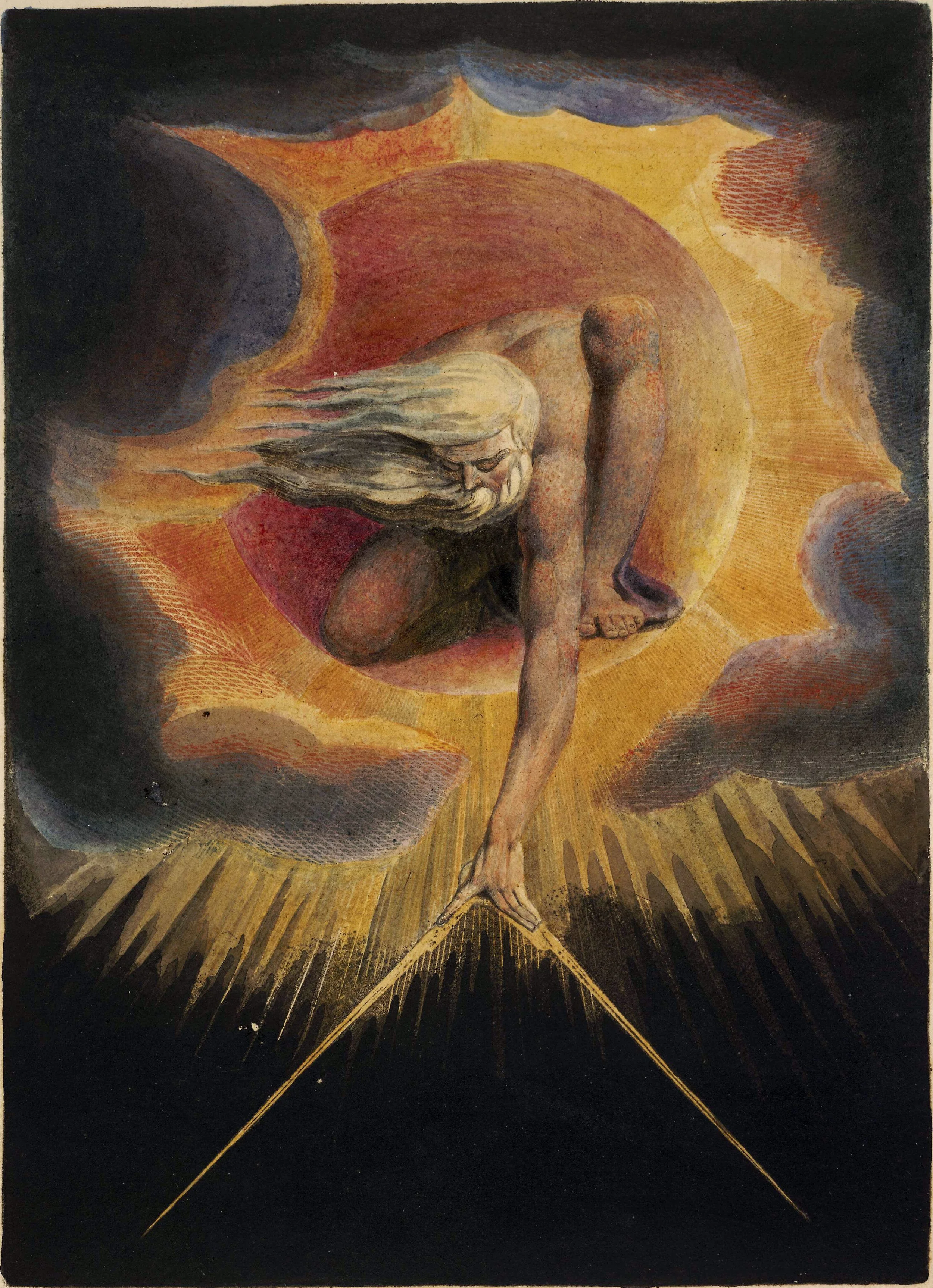
William Blake The Ancient of Days (frontispiece to Europe: A Prophecy) 1794
I hope that what follows comes across as a sincere inquiry, not some kind of Canute-like conservative reflex or technophobia. New to the topic and straying far outside my swimlane, I call upon my expert witnesses.
***
The French philosopher Maurice Merleau-Ponty spent his career arguing that the idea of the mind as our primary vehicle for knowing the world (and ourselves) was wrong. Arguing that we don't so much 'have' as much as 'inhabit' our bodies, he distinguished between what he called the 'objective body' - the body as physical object - and what he called the 'lived body'; the body through which we touch and feel and move - the centre of our world. As he put it in his Phenomenology of Perception (1945) "The body is our general medium for having a world." The body, for him, was the very structure through which any encounter with reality is possible at all - "our anchorage in the world." It seems obvious once it's pointed out - we do not perceive and make sense of the world from nowhere. We are always situated somewhere, physically, bodily - always located in and part of a physical context and fabric that already has meaning.
In Descartes' Error (1994), the neuroscientist Antonio Damasio built the clinical case for embodied knowledge. His so-called somatic marker hypothesis - the idea that the body flags relevant emotional history before the mind has consciously weighed the options - was developed through his study of patients with damage to a specific region of the frontal brain. His central clinical case was a man he calls ‘Elliot’ in the book, who had suffered damage to the prefrontal cortex as the result of a brain tumour and its surgical removal. By every standard measure of cognitive function, Elliot was intact - intelligence, memory, language, perception, logical reasoning, even the ability to discuss ethical dilemmas lucidly and reach the correct conclusions. What he lost, however, was the capacity to act on any of it in the domain that mattered most - in personal and social decisions. He could analyse options, weigh consequences, reason his way through problems put to him, but he consistently made decisions that destroyed both his professional and personal life. It was precisely in the personal, the social, the relational - where emotional signals were required to guide judgment - where he could not longer fully function. The somatic markers - the bodily signals that carry the emotional history of a choice before the mind has consciously weighed it - had fallen silent. Damasio sought to corroborate this finding with a famous historical case - that of one Phineas Gage, a railway foreman who in 1848 had a tamping iron blown through his skull, destroying the same region. Gage survived for twelve years - but the man who emerged from the accident was, as his phsyician recorded, no longer quite himself. Damasio's title named the underlying error his worked challenged - Descartes' belief that thinking can be separated from the body that does it.
***
The shift in trauma treatment to incorporate Eye Movement Desensitisation and Reprocessing (EMDR), somatic experiencing, and body-based interventions over the last thirty years grew out of the limitations of purely talk-based approaches. Bessel van der Kolk's The Body Keeps the Score documents the finding that traumatic memory is not stored narratively. It is stored in the body - as sensation, as posture, as the nervous system's own regulatory rhythms, below conscious reach - and the person doesn't so much remember the event as live it again. Psychotherapist Peter Levine, watching how animals discharge trauma through shaking and trembling and the completion of interrupted physical responses, concluded that humans have the same biological resolution mechanism. We have, it seems, just been talking over it for decades.
Neuroscientist Stephen Porges' polyvagal theory - his account of how the nervous system moves between states of threat and safety - showed that this shift cannot simply be willed or reasoned into being. The pathway back to safety runs through the body: breath, posture, and the physical proximity of another human being. "If you want to improve the world," Porges wrote, "start by making people feel safer."
The body as the ground of knowing. The body as the ground of deciding. The body as the ground of healing. The cognitive scientists Francisco Varela, Evan Thompson, and Eleanor Rosch add a fourth: the body as the ground of cognition itself - not just what we know, but how thinking happens at all. In The Embodied Mind (1991), they argued against the dominant computational model of mind - the idea that cognition is a matter of an inner mind representing an outer world, as Altman would have us believe. The mind they argued, doesn't merely stand apart from the world and model it. It moves embodied through the world, acts on it and is shaped by it, and in that ongoing exchange, knowing arises.
To all this, we can add the insight of the Tantra tradition. It feels rather necessary to acknowledge that the word ‘Tantra’ will, in Western ears, almost inevitably conjure something to do with sex and candles and Sting, when in actual fact it is a vast philosophical and contemplative tradition. Developed over fifteen centuries across the Indian subcontinent, its central preoccupation is the nature of consciousness and its relationship to embodied experience. The sexualised version that reached the West was a highly selective import, stripped of its philosophical content and enquiry.
That vast tradition - developed by thinkers like Abhinavagupta, the tenth-century Kashmiri polymath, philosopher, mystic, poet and aesthetician - held that the body is not merely where knowledge is grounded, or where decisions are made, or where healing must eventually arrive. Rather than being an obstacle to knowledge, the body is the very medium through which consciousness actually comes to know itself. Sensation, feeling, desire, fear, hunger, pleasure, etc. are not mere noise in the system of knowing or just so much inconvenient biological overhead. They are, in the Tantric account, how reality actually makes itself known. To be without a body is not to be a purer form of consciousness - it is to be excluded from the most fundamental mode of knowing there is.
Consider smell. In the words of the poet Diane Ackerman, in A Natural History of the Senses (1990), "Smell is the mute sense, the one without words." Being a poet, Ackerman is deliberate in her choice of words. Smell is not mute because it is difficult to articulate, but because it lies outside language. Unlike every other sense, the neural pathways from the olfactory system run more directly to the limbic system - the seat of our emotional memory - than through the thalamus, the brain's filtering layer for sensory information. Smell arrives faster, and earlier, than cognition has assembled its reasons, explanations, and stories. You don't re-encounter the smell of your mother's kitchen when she's making marmalade and then feel something. The feeling and the sweet, intoxicating smell are the same event. A language model trained on every account of petrichor (who knew that there was a word for the smell of rain on dry earth?!) ever written does not know what rain on dry earth smells like. It just knows about it.
Abhinavagupta's tradition insists on what it calls jīvanmukti - liberation while still embodied. Not liberation from the body, into some disembodied state of pure cognition. Liberation through the body, in the body, as the body comes to recognise itself as an expression of the consciousness it was always part of. This is the opposite of the idea, handed down to us from Descartes, that mind and body are separate, with the mind as the real thing and the body its accidental container. And it is the opposite of what a culture is doing when it treats systems that have no body as the natural destination of knowing.
***
Enough with the scientists and philosophers - the artists too have much to teach us about what the body knows. Take Francis Bacon. In his interviews with the art critic David Sylvester, he kept returning to the same theme - he wanted "to record one's own feelings about certain situations as closely to one's own nervous system as one possibly can." What he was after was not a depiction of the subject, but the nervous system's direct account of encounter. "It's a very, very close and difficult thing," he said, "to know why some paint comes across directly onto the nervous system and other paint tells you the story in a long diatribe through the brain."
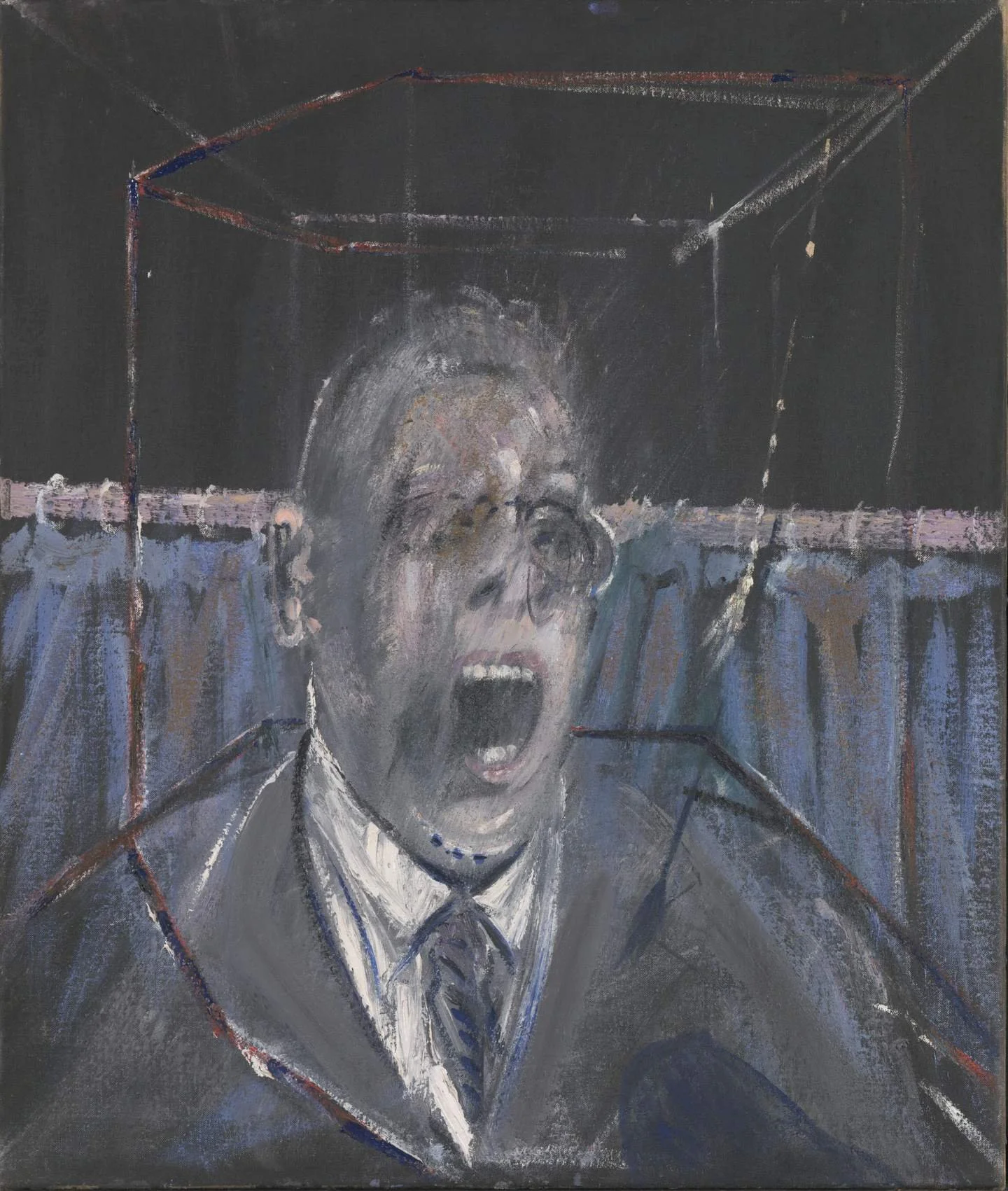
Francis Bacon, Study for a Portrait, 1952
Or take Agnes Martin, who was arguably one of the most important artists of the twentieth century. She’s described waiting, sometimes for days, until what she called inspiration arrived: "I'm very careful not to have ideas, because they're inaccurate." Waiting not for a concept, but a sensation, the painting coming first as a feeling.
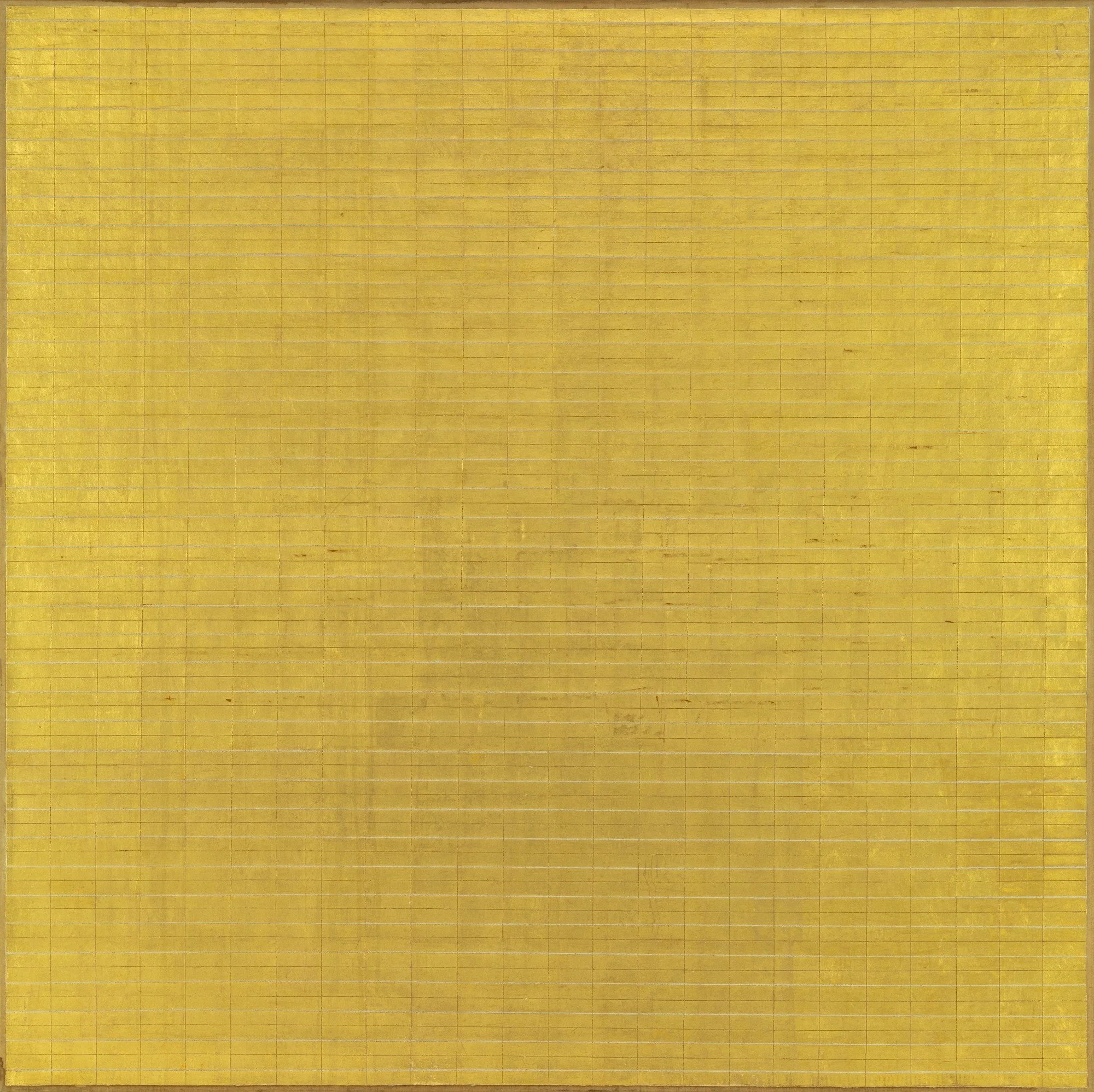
Anges Martin, Friendship, 1963
One artist working in the most visceral language, the other in the most reduced, both reporting the same experience from the canvas.
Take too Robert Adams, who for fifty years photographed the landscapes of the American West, located the same knowing at the other end of the process - not in how the work begins but in how you know when it is finished. His search was for a frame where everything fits - a reminder of "those rare times when you did see the world so that everything seemed to fit - so that things had consequence." Consequence. The felt sense that what was inside the frame pointed to a wider coherence in life as a whole, that the otherwise chaotic world means something. That recognition of fit is felt in the body before it can be articulated and rationalised.

Robert Adams, Ranch. Northeast of Keota, Colorado, 1969
Ernst Gombrich, as a historian of art rather than a creator of it, arrived at the same place. It is only when we understand what the artist means by that modest little word "right," he wrote, that we begin to understand what artists are really after. The neuroscience lends some support. Semir Zeki, who spent decades mapping what happens in the brain during aesthetic experience, scanned subjects while they viewed paintings and listened to music they had pre-rated for beauty. Of all the brain regions active during those experiences, only the medial orbitofrontal cortex was consistently active during both musical and visual beauty. It is, as it happens, the same general region involved in Damasio's somatic marker work - where emotional history and bodily signals are integrated into something felt before the mind has assembled its reasons and stories.
***
There is an obvious objection to everything that precedes this sentence. If embodied knowledge cannot be transmitted in language, what exactly is this post doing? The answer lies in recognising the limitations of language. The fact is that language - including these words, straining for coherence and meaning that you are reading here - cannot carry all that the body knows. What language can do however, is that it can point. It can direct our attention back toward a similar experience the reader has already had, in their own body, and name what was happening in it. This is not instruction or the downloading of data, but an invitation to the reader to recognise something already in themselves. Recognition only works if the knowledge is already there - encoded in the nervous system, in the body’s history of encounters and moments and experiences.
So if this is landing with the reader:
"How beautiful he felt, how pure in tissue! How lovely, how lovely, strong, and yet pure and delicate, such stillness of the sensitive body! Such utter stillness of potency and delicate flesh. How beautiful! How beautiful! Her hands came timorously down his back... The unspeakable beauty to the touch of the warm, living buttocks! The life within life, the sheer warm, potent loveliness."
D.H. Lawrence, Lady Chatterley's Lover (1928)
… it is landing because the reader's body already knows what the intimate, erotically-charged touch of another feels like. The words do not bring the knowledge, they just point at it.
If this description of young Georgie chasing a paper boat down a rain-swollen gutter, and reaching into a stormdrain to retrieve it, lands…
"He dropped to his knees and peered in. The water made a dank hollow sound as it fell into the darkness. It was a spooky sound. It reminded him of -'Huh!' The sound was jerked out of him as if on a string, and he recoiled. There were yellow eyes in there: the sort of eyes he had always imagined but never actually seen down in the basement... 'Hi, Georgie,' it said… There was a clown in the stormdrain… The clown seized his arm. And George saw the clown's face change. What he saw then was terrible enough to make his worst imaginings of the thing in the cellar look like sweet dreams; what he saw destroyed his sanity in one clawing stroke."
Stephen King, It (1986)
… it lands not because the words are carrying an information payload of fear. They are finding it where it already lives - in the body of every person who has ever stood at the top of a dark staircase, or reached a hand into somewhere they couldn't see, or felt the specific, physical quality of a space that something might be coming out of. Ever the arch-manipulator, King knows exactly where that knowledge is stored. He points directly at it, encoded in the body’s nervous system long before the page was ever opened.
If these words land:
“A difficult life is not less
worth living than a gentle one.
Joy is simply easier to carry
than sorrow. And your heart
could lift a city from how long
you’ve spent holding what’s been
nearly impossible to hold.
This world needs those
who know how to do that.
Those who could find a tunnel
that has no light at the end of it,
and hold it up like a telescope
to know the darkness
also contains truths that could
bring the light to its knees.
Grief astronomer, adjust the lens,
look close, tell us what you see.”
Andrea Gibson, ‘Grief Astronomer’, 2021
… they land not because they’ve delivered an information package that tells you what grief feels like, but because (being human) you already know what grief and loss and the bigger truths they reveal feel like. In your body. The words just point to that.
***
None of this means the machines are useless. I've just finished building a personal AI workflow around my strategic practice, and as somebody who had no knowledge of the space I’ve been exploring here, the machines have been my invaluable research partners. Of course the machines are not useless. But the AI debate has inherited a centuries-old account of the world - knowledge is information in the mind. The philosophers and cognitive scientists have been making the case against this for decades. The problem is that the discourse and prophecy around AI hasn't absorbed it. Remove the body and you do not get purer thinking. You just get thinking that has lost its grip on the world it is supposedly describing.
***
The expert witnesses I have called upon are obviously not saying identical things. Merleau-Ponty is making a claim about the structure of lived experience. Damasio is making a neuroscientific claim about the decision-making. Blake is making a claim about the pathology of a culture that has elevated one faculty at the expense of everything else. Varela, Thompson and Rosch are making a claim about cognition as not being something the brain does to the world but something that emerges through the body's active engagement with it. Abhinavagupta is claiming not merely that knowledge is grounded in the body, but that the body is where reality becomes accessible to us.
These are distinct claims about embodied knowing, and I have to acknowledge my own vast ignorance (lest it not be obvious) and that I come to all of them as a curious layperson straying far, far outside my swimlane. The experts and specialists in any of these fields will, I am sure, find things to contest, though I’d argue that these arguments are no more contestable than the arguments being made, daily and with enormous confidence, for the replacement of embodied human knowing with disembodied computation. The people building those systems are not more rigorous than Merleau-Ponty or Damasio. They simply have a bigger voice, are better funded, and less inclined to acknowledge what they don't know. What the thinkers I have drawn on all share, despite their differences, is the rejection of the assumption that the mind is the seat of knowing and the body merely its housing. But the body is not the problem - it is the point.
***
Follow the logic that intelligence is separable from the organism that generates it and you arrive eventually at the vision of an AI that "knows you deeply, understands your goals" and that will help you "be a better friend to those you care about, and grow to become the person you aspire to be." It is, on its surface, a warmer and more humanistic pitch than some of what we hear. It is also tragically blind to the human experience.
In Pragmatics of Human Communication (1967), the psychologists Watzlawick, Bavelas and Jackson distinguished between what they called digital and analogue communication. By 'digital' they meant communication that is logical and explicit - the transmission of information about objects and events. ‘Analogue’ communication by contrast they argued, encompasses virtually all non-verbal exchange: implied, open to interpretation, experienced largely below the threshold of conscious awareness. Their conclusion was unambiguous:
"Wherever relationship is the central issue of communication, we find that digital language is almost meaningless. This is not only the case between animals and between man and animals, but in many other contingencies in human life, e.g. courtship, love, succor, combat."
A personal superintelligence is, by its nature, a digital system. What is being offered to help you - with friendship, becoming, love - is conducted almost entirely in the analogue register that a digital system cannot enter.
This is a categorical error. Becoming a better friend requires the accumulated friction of actual friendship - the 2am call that wrenched you out of slumber and you didn't want to take but did; the thing you said that landed wrong and made your stomach turn to think about it; the hug you surrendered to that felt like a lifeboat; the way you knew you weren't being honest with yourself as the words came out of your mouth; the knowing sidelook they gave you that made you know you'd be Clyde to her Bonnie for life… the years of showing up in a body to someone else's body. Becoming the person you aspire to be requires a world that pushes back - the job you didn't get, which you knew before you'd finished reading the email because your stomach already had the answer; the run you couldn't finish and the hangover that lasted two days that were telling you something you had yet to name; the way that - having stoically not shed a tear - the garden suddenly felt so quiet and empty, after you had to say goodbye to the old, deaf, smelly dog and you realized that you had secretly loved him; the room that you walked into and knew, before a word had been spoken, was wrong - but stayed in anyway, for another eighteen months; the loss that didn't become real until you longed for your father’s helping hands, and then did.
These subterranean pangs, these sinkings, these knots and butterflies in the stomach, the tightness in the chest, the jaw that won't unclench, that sudden lightness when something resolves, the warmth that spreads when you finally hear the true thing you longed to hear, the lift of finally knowing what's right… all these and more are the essential process, not an inefficiency that can be subcontracted and optimised. So a system that removes what we feel in our bones and heart and gut is not helping you grow. It is offering you the illusion of growth - replete with the appropriate vocabulary, the appearance of insight, and the feeling of progress - without any of the encounters and moments and frictions you can't run or hide from that actually make any of it real.
***
The question all this inevitably raises is this: if the argument is right, what does resistance actually look like? Some serving suggestions:
It looks like taking seriously Merleau-Ponty's insistence that we are never the detached observer, never the view from nowhere - that we always find ourselves already involved, already embedded, already in a particular physical and social situation and that we cannot untangle ourselves from that embedding. In a world where soils are being depleted faster than they can regenerate, where insect populations are collapsing, where we are collectively heating the atmosphere of the only planet we have, accommodating ourselves to this truth feels desperately urgent. It matters because the more honestly we attend to that embeddedness, the harder it becomes to maintain the corrupting and self-defteating fiction that we stand apart from the natural world as its managers, extractors, and financialisers. We are not outside nature looking in.
It also looks like taking seriously what the yoga tradition has been demonstrating for three thousand years and what Western somatic research has been confirming for the last thirty: that the body is not merely a vehicle you inhabit but a capacity you can develop - that attention, practice, and sustained physical engagement can expand what the body knows and how precisely it knows it. Classical yoga is explicit about this knowledge. Patanjali's ‘eight limbs’ - codified in the Yoga Sutras more than 1,600 years ago - move deliberately from outer to inner: ethical conduct, physical posture, breath regulation, withdrawal of the senses from external objects, concentration, meditation, absorption. The sequence is about using the body as a method of knowing - not transcending the body but attending to it so precisely that the usual incessant noise of the chattering mind finally quiets and something else becomes accessible. The body is not excluded, as Descartes would have it. It is the instrument of the investigation. B.K.S. Iyengar - who practised and taught yoga for the better part of eight decades, and whose 1966 Light on Yoga became the definitive reference for generations of practitioners - put it plainly: "My body is a laboratory, you can say. I don't stretch my body as if it is an object." Not a cage to escape, but laboratory. -a site of investigation in which the practitioner is at one and the same time both the scientist and the experiment. Sustained practice - attention to breath, to all the micro-sensations of posture, to the felt quality of the body's engagement with gravity and resistance - does not merely improve physical capacity. It progressively refines the practitioner's perceptual access to their own bodily states. The direction of attention is mind through the body, not mind over the body. “My mat is my laboratory”, as my wife would always say.
It looks like recovering the understanding that knowledge of the kind that most matters - the knowledge for example, of how to be with another person, of when a work of art is finished, or of what a situation is really asking - has never been transmissible as information. It passes between people, through presence, through ritual, through sustained attention.
It looks like demanding and valuing an education that treats the development of the whole person - not just the transmission of employable skills - as its central purpose. The body learns through doing, through making, through physical encounter with resistant material, laws of physics, and other human beings. As the philosopher, psychologist, and educational reformer John Dewey wrote:
“An environment that was always and everywhere congenial to the straightaway execution of our impulsions would set a term to growth as surely as one always hostile would irritate and destroy. Impulsion forever boosted on its forward way would run its course thoughtless, and dead to emotion. For it would not have to give an account of itself in terms of the things it encounters, and hence they would not become significant objects. The only way it can become aware of its nature and its goal is by obstacles surmounted and means employed; means which are only means from the very beginning are too much one with an impulsion, on a way smoothed and oiled in advance, to permit of consciousness of them. Nor without resistance from surroundings would the self become aware of itself; it would have neither feeling nor interest, neither fear nor hope, neither disappointment nor elation. Mere opposition that completely thwarts, creates irritation and rage. But resistance that calls out thought generates curiosity and solicitous care, and, when it is overcome and utilized, eventuates in elation.”
An education that removes the necssary lived friction in favour of measurable cognitive output and treats everything else as extracurricular, is producing people who have been trained to perform competence while being systematically deprived of the conditions in which genuine knowing develops.
It looks like taking seriously what is happening to a generation growing up increasingly alone, increasingly without the physical and social friction that builds a self. The WHO Commission on Social Connection's July 2025 report finds that one in five teenagers aged 13 to 17 now experiences loneliness - and that figure is highest among the young. According to a Washington University in St. Louis study published in February 2026, people who report loneliness have almost three times the odds of meeting the criteria for depression and nearly four times the odds of meeting the criteria for generalised anxiety. These are not just diseases of the mind. They are the consequences of a nervous system that has been deprived of what it requires to develop. In nationally representative samples of 8.2 million US adolescents tracked from 1976 to 2017, teenagers in the 2010s spent significantly less time in face-to-face interaction with peers than previous generations - and college-bound seniors in 2016 were spending a full hour less per day with friends in person than their counterparts in the late 1980s, despite working less and studying no more. Allan Schore, whose decades of research on early brain development have shaped both neuroscience and clinical practice, argues that the right hemisphere of the developing brain - the seat of emotional regulation, bodily self-awareness, and the capacity for empathy - is built through face-to-face interaction, through being seen by and attuned to another embodied person. Screen time does not substitute for this. It requires bodily presence. You cannot screen-substitute your way to a nervous system, or app your way to a self. The infrastructure that produces human beings - not just human minds - requires bodies in rooms together, over time, doing things that matter.
And above all it means giving ourselves permission. Permission to call out that the vision of the future being sold to us - frictionless, disembodied, optimised, with a personal superintelligence that knows you better than you know yourself - is just that: a vision, a point of view, not the final incontrovertible truth. It has been constructed, funded, and narrated by people with a very specific set of interests in its adoption, and the confidence with which it is presented is a function of their capital, not of its truth. We are not obliged to receive it in its entirety as fact. We are entitled to notice that it encodes and presents a set of contestable assertions and assumptions about what knowledge - and indeed what a human being - is that are not neutral. The question is not whether to engage with the technology, or whether it is useful. The question is whether to accept, along with the technology, the anthropology, ideology, and cultural agenda it smuggles in with it.
***
Back in 1855, the American poet Walt Whitman asked the question that the whole of Western philosophy since Descartes has been refusing to answer honestly. He asked it in his poem 'I Sing the Body Electric,' and nobody in Silicon Valley appears to have read it:
“And if the body were not the soul, what is the soul?”
The word 'soul' will I know, make some want head for the exit. But Whitman is not making a theological claim. He is not saying the soul inhabits the body, or animates it, or will one day leave it. He is asking what is the seat of feeling, of experience, of understanding, of knowledge, of agency if it is separable from the body. When our latter-day ascetics seem, like the medieval monastics of old, to regard the body as the problem - the meat, the decay, the dependency, the thing that stands between the mind and its freedom - Whitman saw it as the answer. It was Nnot a cage to be transcended, but the very site of everything that matters.
At the end of the poem, and having named head, neck, hair, ears, eyes, eye-fringes, iris of the eye, eyebrows, eyelids, mouth, tongue, lips, teeth, roof of the mouth, jaws, and the jaw-hinges, nose, nostrils cheeks, temples, forehead, chin, throat, back of the neck, neck-slue, shoulders, scapula, hind-shoulders, chest, upper-arm, armpit, elbow-socket, lower-arm, arm-sinews, arm-bones, wrist and wrist-joints, hand, palm, knuckles, thumb, forefinger, finger-joints, finger-nails, breast, breast-bone, ribs, belly, backbone, hips, hip-sockets, penis, tescticles, thighs, pelvis, legs, knee, ankle, instep, foot, toes, toe-joints, nail of the toe, heel, calf, lung-sponges, stomach, bowels, brain, heart-valves, palate-valves, womb, and nipples, Whitman arrived at the same conclusion reached by the philosopher Merleau-Ponty from the study of lived experience.
By Blake from diagnosing what a culture loses when it severs abstraction from the life that generates it.
By the scientist Damasio from studying brain damage.
By the trauma clinicians van der Kolk, Levine and Porges from decades of hard-won clinical reckoning.
By Varela, Thompson and Rosch from the finding that knowledge is built from encounter not retrieval.
By Zeki from the discovery that beauty and aesthetic rightness share the same part of the brain where the body's history of encounter is integrated into something felt before the mind has assembled its reasons.
By the artist Agnes Martin waiting for the painting to arrive as sensation before it arrived as idea.
By Francis Bacon reaching for what lands directly on the nervous system.
By Robert Adams learning to recognise in his body before his mind when everything in the frame was finally right.
By Abhinavagupta and fifteen centuries of philosophical enquiry into the nature and experience of reality.
And by Patanjali’s development of a systematic method for attending to the body until it yields what the mind alone cannot reach:
O I say these are not the parts and poems of the body only, but of the soul, O I say now these are the soul!
The body is not a vehicle.
Not a meat sack.
Not a legacy system.
Not a limitation to be transcended on the way to the real thing.
Whitman knew what it was. So do you.
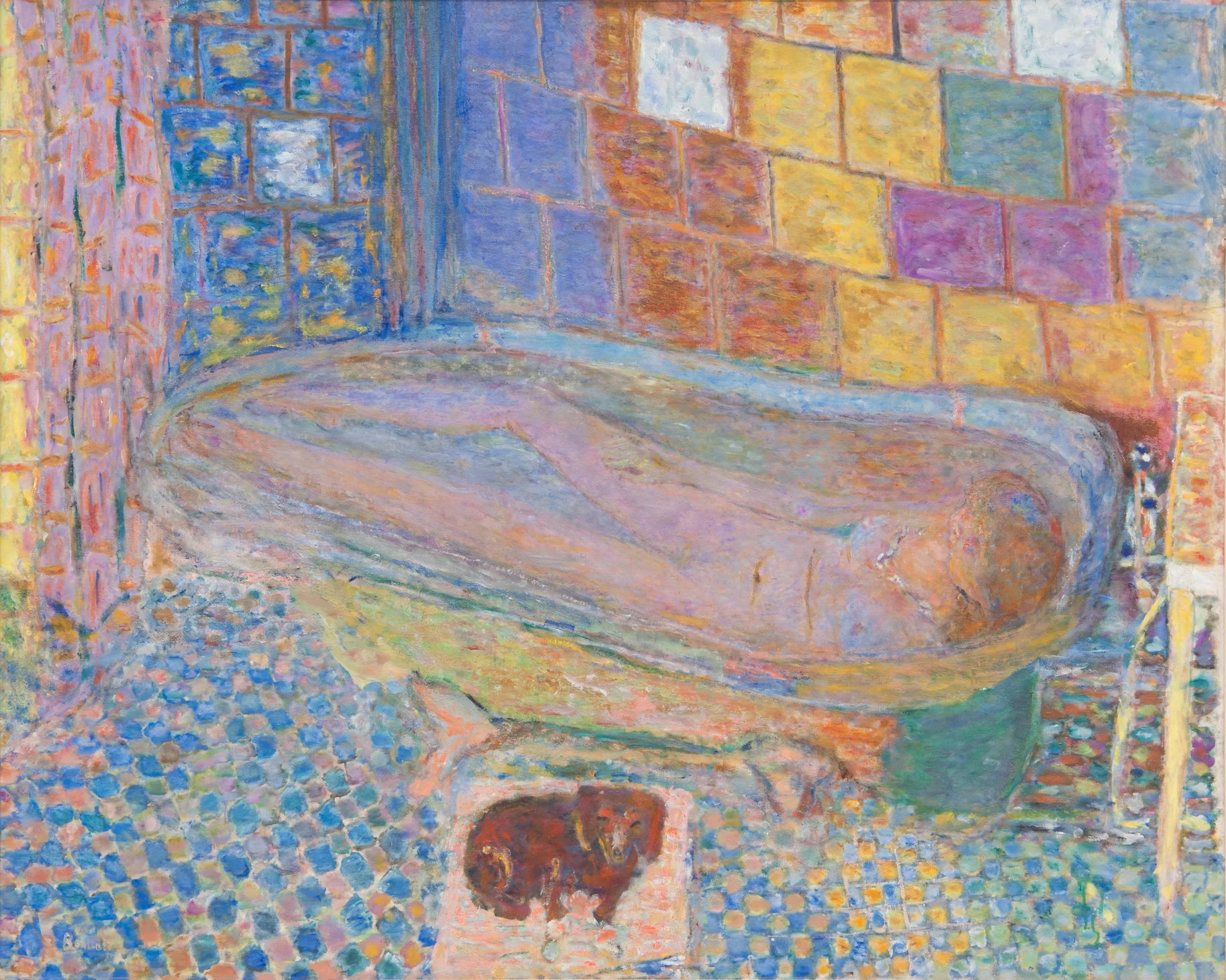
Pierre Bonnard, Nude in the Bath and Small Dog, 1941-46
***
Martin Weigel is a brand strategist, former Chief Strategy Officer at Wieden+Kennedy Amsterdam, and founder of EMDUB. He helps companies find their superpower - and turn it into action.