
Raging Bull (1980), dir. Martin Scorsese. © MGM/UA Entertainment Co.
"Some things are in our control and others not. Things in our control are opinion, pursuit, desire, aversion, and, in a word, whatever are our own actions."
Epictetus
The standard account of AI's strategic challenge to marketing invariably points to collapsing production costs, productivity gains, algorithmic intermediation of search and discovery, commoditisation of craft and creative execution, intelligence as commodity, accelerated product development, workflow automation… All familiar enough stuff. But none of it really addresses what, precisely, you navigate by when the ground is moving, when the technology is not yours, the speed is not yours to set, and nobody apart from the self-styled prophets has any idea what comes next.
It seems to me that there are only two available answers. You navigate by the landscape - by the latest signal, the loudest prediction, the most visible shift or trend. Or you navigate by yourself. By a clear-eyed account of what you are, what you believe, what value you exist to deliver, and what you will and will not do in service of that.
The first approach feels responsive, but it is actually just reactivity, dressed up as strategy, which is probably why the organisations doing it tend to look busy without going anywhere in particular.
The second approach requires an answer to a question many organisations have neglected: who are you? No, don’t point to a brand pyramid or onion, or some flat-footed positioning statement, or some aspirational values you had stenciled on your walls. Really - who are you? This demands work, and to my mind nobody understood this better, or stated it more plainly, than Dolly Parton: "Find out who you are, and do it on purpose." The sequence matters - find out first, and then act with intentionality. It is the difference between identity expressed through deliberate choice and identity revealed by default because you didn't do the hard work.
Dolly's question is the question Steve Jobs put to a room of Apple employees, in September 1997. Apple was weeks from bankruptcy. It had just been through a decade of strategic incoherence, product failure, and brand drift so severe that Michael Dell, asked at the Gartner Symposium that October what he would do if he were running Apple, replied: "I'd shut it down and give the money back to the shareholders." Jobs had been back as interim CEO for two months. Customers, he told the room, want to know "who is Apple and what is it that we stand for? Where do we fit in this world?"
The trouble is that a generation of businesses stopped taking this question seriously.
***
Byron Sharp’s How Brands Grow, published in 2010 and now treated as something close to holy writ in marketing departments around the world, established two conditions for brand growth:
Mental availability, i.e. the accumulated memory structures that predispose the roughly 95% of people who are out-of-market at any one time to think of your brand when they do come to purchase moments (the 95% figure comes from Professor John Dawes's research at the Ehrenberg-Bass Institute - a heuristic rather than a precise law, but a useful one.)
Physical availability, i.e. how easy the brand is to find and buy - which in practice today means not just shelf space and distribution, but e-commerce presence, search visibility, retargeting, programmatic, retail media, and paid social: everything that catches the 5% who are in-market and ready to consider a purchase.
Sharp maintains that brands need both, but that without building memory structures through advertising, no amount of performance advertising would deliver growth.
McKinsey's State of Marketing Europe 2026 report reported that "Across sectors, about 70 percent of surveyed marketing leaders emphasized that purpose-driven, authentic brand experiences are essential for building distinctive emotional connections with customers, differentiating the brand, and driving sustainable business growth". And in 'The State of Performance Marketing', Adobe and MMA Global’s 2025 survey of 389 senior marketing professionals found that less than 20% of marketers described themselves as “performance-led”.
However, put away those cigars. The very same Adobe/MMA Global study found that 57% of marketing budget goes towards performance marketing, with 23% of marketers having increased their performance allocation in the prior year and just 7% having decreased it. Meanwhile a 2025 survey of more than 250 CMOs and senior marketing decision-makers across 14 countries conducted by NIQ (formerly NielsenIQ) and published as ‘CMO Outlook: Guide to 2026’ found that C-suite support for long-term brand investment had dropped 11 percentage points from 80% the previous year to 69%.
At the same time, 84% of CMOs now cite ROI as their primary budget allocation metric. Which sounds entirely reasonable until you remember that ROI can only measure what is measurable - and brand effects, which accrue slowly and show up years later in pricing power, market share, and customer acquisition costs, are not measurable in the quarter in which they are built. So the metric doesn't just describe the goal of the budget, it actively shapes it.
So we read the marketing science (or at least absorbed the headlines) publicly agreed with its implications, subscribed to the long-term economic value of investing in brand, identified ourselves as believers in brand... and then invested in short-term performance marketing at the expense of brand. This is what psychologists call belief-behaviour decoupling, and what you and I would call acting against our own better judgement. Michael Farmer is more damning, and while he said this of agency executives, I tend to think it applies to more than just them - “They must know and not know, think and not think, work with commitment and admit to no one the uselessness of much of what they do.” Such is the pressure to show short-term results, the timescale of the damage and the timescale of the incentive structure failing to overlap. It’s what Mark Carney when Governor of the Bank of England called “the tragedy of the horizon” - not a failure of intelligence but a structural condition in which rational actors, each behaving sensibly within their own horizon, collectively produce an outcome that is catastrophic. Nobody is villainous, just the system .
Michael Farmer’s analysis of sixty major advertisers in the US over the fifteen years from 2009 to 2024 demonstrates that 2/3rds of them saw their sales growth rates fall to well below the nominal GDP growth rate of 4.7% (2.4% inflation plus 2.3% real growth). The list is not composed of marginal players: it includes the likes of P&G, Unilever, McDonald's, Colgate, Nestlé, and Toyota. Amongst the culprits Farmer identifies are what he sees as CMOs having become implementers of cost-reduction strategies rather than brand-growth strategies, and the “massive migration away from brand-building deliverables”.
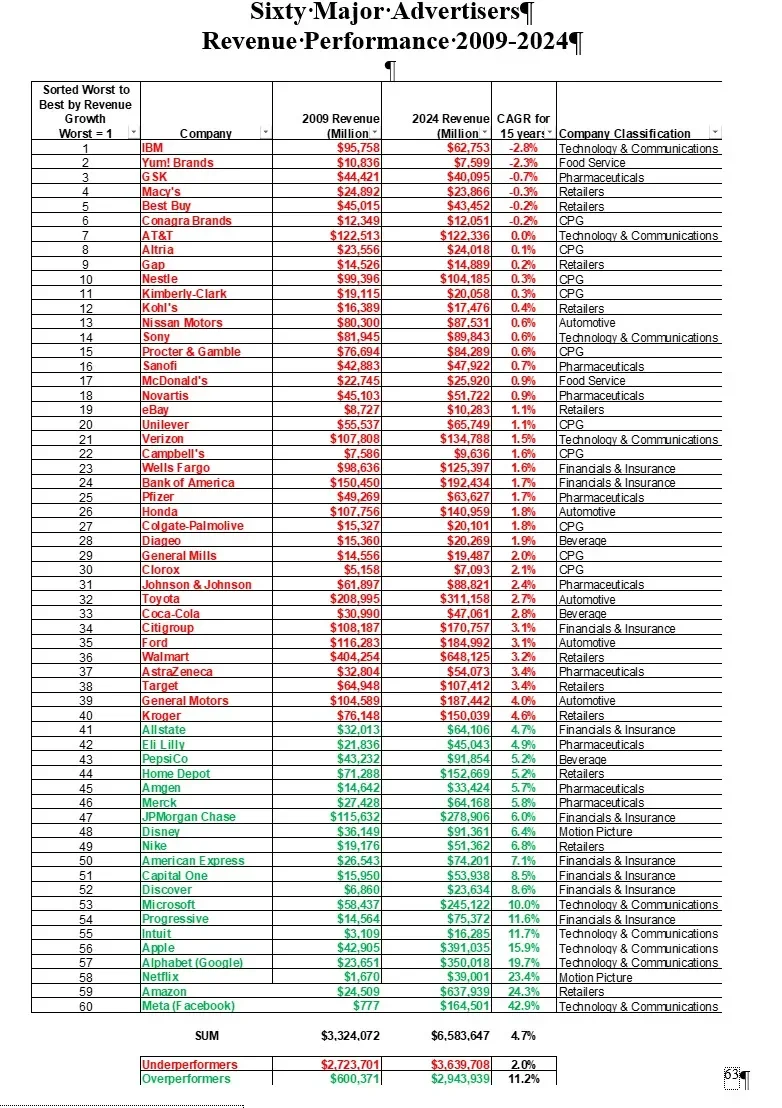
Source: Michael Farmer, ‘Why Have Most Advertisers Suffered From Slow Brand Growth Rates Since 2009? Ten Major Reasons’, 30th March 2026
***
Warren Buffett, in his 2001 letter to Berkshire Hathaway shareholders, wrote: “Only when the tide goes out do you discover who’s been swimming naked.” He was writing about credit risk and over-leveraged businesses in the aftermath of the dot-com collapse. But the structural observation holds for marketing.
Insurgent brands - nimble, founder-led, authentically positioned- are occupying the territory vacated or left defenceless by legacy brands. According to Bain & Company's 2025 Insurgent Brands research, brands accounting for less than 2% of market share in their categories captured nearly 39% of incremental category growth in 2024, up from 17% the year before. In personal care alone, insurgents held 3% of market share while taking 45% of category growth. These are not fringe players disrupting fringe categories. They are eating the lunch of P&G, Unilever, and Nestlé - the same companies whose brand underperformance Farmer has spent years documenting. Even the world's largest sports brand discovered that optimising for controllable, measurable direct channels at the expense of the broader brand ecosystem creates exactly the kind of vacuum insurgents are designed to fill.
Insurgents are not the only threat. Farmer identifies a second front: the rise of private label. As major retailers have grown in scale and sophistication, they have become trusted brands in their own right - and their own-label products can now credibly compete with the advertised majors on quality, not just price. Having devoted the lion’s share of resource to trade spend - so things like shelf placement, promotional compliance, and retail media mandates that function more like a tax than an investment - at the expense of the brand-building, packaged goods brands find themselves struggling to justify the premium just as a cost of living crisis hits.
Meanwhile the algorithmic infrastructure that performance marketing was built on - paid search, last-click attribution, the reliable capture of in-market demand - is being slowly dismantled by AI. Google's AI Overviews, which appeared in fewer than 7% of searches at the start of 2025, peaked at roughly one in four by mid-year and have settled at around one in five - a share that continues to grow and is expanding into commercial and transactional queries where performance budgets are most heavily concentrated. Around 60% of searches now end without a click at all, according to SparkToro's large-scale clickstream research - meaning the open web receives just 360 clicks per 1,000 US Google searches. The channel that delivered the measurable, immediate return that justified a decade of short-termism is becoming measurably less reliable, at exactly the moment when brands have hollowed out the mental availability that would make them the default choice when the algorithm steps aside.
These are of course, just a few of the tectonic shifts. But the conditions are changing, the tide is going out, and we are discovering, at scale, who has been swimming naked.
AI removes the last remaining cover. In a world where everyone has access to the same generative capabilities, at the same cost, at the same speed, the only thing that differentiates one organisation's output from another's is the quality and specificity of the self-knowledge it was built from. If the model cannot clearly summarise what your brand stands for, what makes it different, and why someone should choose it, the issue is very probably not the model. It is usually that the brand itself lacks articulated clarity. So the good news is that AI will force marketers to answer the question it has spent the best part of two decades neglecting - "who are you?”
That question is becoming more urgent, not less. As my old strategic partner in crime Andy Bateman of Mixtape Partners has recently observed, the next customer may not be human. As AI agents increasingly mediate buying decisions - researching, comparing, filtering, and in some cases completing transactions on behalf of users - the brand is no longer communicating only with people. It is being read, interpreted, and acted upon by systems that have no patience for ambiguity, no tolerance for inconsistency, and no capacity to infer intent from tone. A reductive proposition - a tagline, a promise, a campaign platform - gives an AI agent almost nothing to work with.
It will also force marketers to confront the inconvenient truth that - short tenures, temporal discounting, and the ability of marketing teams to get bored with their own output before the consumer does notwithstanding - it pays to be consistent. LLMs work by prediction, and a brand that has shown up inconsistently or faintly over time gives the model nothing reliable to predict from. The same discipline that builds mental availability in humans turns out to be what builds legibility for machines.
"Find out who you are, and do it on purpose", said Dolly. Consistency and clarity of identity were always the right answer. They are now the answer on two fronts simultaneously and the organisations that have done the upstream work are not merely better positioned to communicate with human audiences. They are better positioned to be accurately represented by the systems that increasingly stand between them and those audiences.
This will be a bit inconvenient for those for whom "DBAs" (distinctive brand assets) or what forty years ago we used to call "brand properties" - colours, logos, characters, shapes - have become something of a band-aid: a way of appearing to think seriously about brand while avoiding the harder question underneath. Like what it represents in the mind of the consumer. DBAs were engineered for human eyes, but the LLM is indifferent to your colour palette. What it rewards is verbal distinctiveness, conceptual consistency, and clarity of positioning - the things that show up in language, repeated across every surface where your brand has ever appeared, and that allow the model to predict, reliably and specifically, what you stand for and offer. So if nothing else, the LLMs will act as a forcing function for finally getting our marketing shit together.
"Marketing needs to identify the full performance potential of its existing brands", writes Michael Farmer. That demands a rigorous (and overdue) account of what you believe, who you're for, and what you exist to do for them that no one else does - and an honest assessment of the gap between that intent and the consumer's experience. You cannot prompt your way around the identity question, automate your way past it, or ask the machine to serve you an oven-ready answer. “Find out” - Dolly's instruction requires honesty about not merely what you said you believed, but what your decisions reveal you believed; what you could do and are choosing not to; and what you have become versus what you intended to be. It requires asking what your customers actually experience, as opposed to what you tell yourself they experience. And it requires asking, perhaps most uncomfortably: what would they actually lose if you disappeared tomorrow - and whether, if they are honest, they would actually notice.
***
The short-term pressures not to do this work - to focus on today at the expense of tomorrow - are not going away. They are the permanent condition of operating a business, not a temporary inconvenience that will resolve itself once things calm down. Things never calm down, and waiting for the moment when the organisation finally has the space to ask the question is waiting for something that will never arrive. And the machine does not wait. It is running right now on whatever self-knowledge your organisation has managed to articulate - and if that self-knowledge is thin, approximate, or simply wrong, the machine will scale the thinness, the approximation, and be wrong at speed and scale.
Find out who you are - before the model tells you, and your customers - that you don't know. And then, and only then, do it on purpose.
***
Sources:
Ahrefs / Search Engine Journal, Google AI Overviews Appear On 21% Of Searches: New Data, November 2025
Adobe and MMA Global, ‘The State of Performance Marketing’, 2025.
Bain & Company, Insurgent Brands Deliver More Value to Consumers and Are Rewarded for It, 2022
Bain & Company, Brands to Watch: Bain & Company Unveils Its 2025 Insurgent Brands List, March 2025
Bain & Company, Insurgent Brands Steal the Spotlight in 2025
Bain & Company, Goodbye Clicks, Hello AI: Zero-Click Search Redefines Marketing, February 2025
Bain & Company, US Insurgent Brands: Powering the Next Wave of Growth, (March 2026)
Andy Bateman, ‘Your Next Customer Isn’t Human’, Mixtape Partners, 18th February 2026
Cadent Consulting Group, Marketing Spending Study, 2024
Mark Carney, 'Breaking the Tragedy of the Horizon - Climate Change and Financial Stability', speech delivered at Lloyd's of London, 29 September 2015.
John Dawes, 'The 95:5 Rule', 2021
Deloitte, Q3 2025 Retail & Consumer Trends
Duke University Fuqua School of Business, Deloitte and the American Marketing Association, The CMO Survey: Highlights and Insights Report, 2024
eMarketer / PLMA, Private Labels Had a Moment in 2025, December 2025
Michael Farmer, ‘Does Marketing Still Believe in Brand Growth?’, 20th May 2025
Michael Farmer, ‘Orwellian "Doublethink" and Programmatic Advertising’, 9th February 2026
Michael Farmer, 'Why Have Most Advertisers Suffered From Slow Brand Growth Rates Since 2009? Ten Major Reasons', 30th March, 2026
Gartner, 2025 CMO Spend Survey: Marketing Budgets Have Flatlined at 7.7% of Overall Company Revenue
Elliott Hill, Nike Inc. Q2 FY2025 Earnings Conference Call, 19 December 2024.
Interbrand, ‘Best Global Brands 2024’, October 2024
Ipsos, ‘Marketing Anchors: The Case for Capability in an Era of Transformation’, March 2026.
Steve Jobs, internal Apple presentation to employees, September 1997
McKinsey, ‘State of Marketing Europe 2026’
NIQ, CMO Outlook: Guide to 2026, November 2025
NIQ, Private Label & Brand Growth - NIQ Global Outlook 2025
Path to Purchase Institute / Keen Decision Systems, Finding the Right Media Mix for CPG Brands in 2025
Private Label Manufacturers Association / Circana (2025), Store Brand Sales Report 2024. PLMA.
Semrush, AI Overviews Study: What 2025 SEO Data Tells Us About Google's Search Shift, December 2025
Byron Sharp, How Brands Grow, Oxford University Press, 2010.
Byron Sharp, Jenni Romaniuk, and John Dawes, How B2B Brands Grow, 2022
Byron Sharp, ‘Prof. Byron Sharp skewers Binet & Field’s 60:40 rule, smashes attention metrics, BVOD ad stacking, multi-channel amplification effect; tells marketers to sack agencies preaching share of voice quotas and bet the farm on always-on reach; Ritson backhanded’, August 2022
SparkToro/Datos, Zero-Click Search Study: For Every 1,000 US Google Searches, Only 374 Clicks Go to the Open Web, 2024
Martin Weigel is a brand strategist, former Chief Strategy Officer at Wieden+Kennedy Amsterdam, and founder of EMDUB. He helps companies find their superpower- and turn it into action.