
A Stock Taking

The end of the year approaches, so I’m writing this as a way of finding out what I now know. After a whirlwind year of motion, decisions, change, and consequence, I needed to pause and reflect what actually changed in my work, my thinking, and my sense of self - and what the year taught me about doing it on purpose.
***
Basketball wisdom
The legendary basketball coach Bobby Knight once said "Everybody wants to win, but few people have the will to prepare to win”. I first came across those words working with Allianz to develop a new brand platform for them. The dominant conversation in the insurance category is about hedging against the possibility that the worst that could happen. As one of the largest insurance providers and asset managers in the world, Allianz flipped that script and set out to demonstrate how a strong foundation allows customers to experience life at its best. Knight’s words have stayed with me ever since, and rather than rush in, I chose to dedicate much of my first year as emdub to prepare.
***
Who are you and what do you do?
The power of a narrative isn’t just for others, the power of a narrative I have learned, is for ourselves. Narratives don’t just provide an organising system for brands and organisations, nor do they just plant a flag in a crowded territory that captures and clarifies one’s unique value for clients. They give us Indies conviction, intent - and also sustenance, since that will have to be self-farmed.
I’d always found it extraordinary how so many agencies of every stripe believed that stuff like “applying creativity to business problems” was a distinctive and differentiated positioning or value proposition. So facing the prospect of no longer being able to surf the authority and story of an employing organisation, I had to create my own. I asked my wife who doesn’t give a rat’s ass for marketing and brands what if (anything) she thought I was good at. “Seeing possibility where others don’t”, she said.
I’d long believed that everybody had a superpower. Every human, every business, and every brand. Over the years I’d helped brands including Allianz, Amazon Music, Booking.com, Coca-Cola, Corona, DeBeers, Decathlon, Electronic Arts, Evian, Facebook, General Electric, Grundfos, Guinness, Heineken, Hewlett-Packard, Instagram, Kelloggs, Mercedes AMG Petronas F1, Meta Reality Labs, Milka, Miele, Novartis, Ørsted, Ray-Ban, Samsung, Smirnoff, The Glenlivet, and Uber find and express their greatest possibility and potential.
So giving myself permission to believe my wife’s insight I doubled own on that, and got to my own narrative and a simple offer:
“A strategy advisory for leaders who want to find the highest-fidelity version of their brand and organisation, articulate their true superpower, and bring it to life with intent, conviction, and authenticity - across every surface where identity meets action. As Dolly Parton put it: “Find out who you are, and do it on purpose”.
Both finding out who you are and doing it on purpose - being better than you ever thought you could be - demands work.
Finding out who you are requires the courage to look unflinchingly at what’s real - the messy, contradictory, sometimes unflattering truths about what drives you, what you fear, what you stand for, and the true value you bring to people’s lives. It means peeling back stories you’ve inherited or constructed until what remains feels not just true, but freighted with potential.
Doing it on purpose, meanwhile, is the harder grind of alignment and commitment - of expressing that truth coherently and consistently across every surface area of a brand and business. It means translating belief into shared and consistent behaviour, principle into practice, and narrative into lived experience. It’s how conviction takes form in the world - not as words, but as ways of working, choosing, and creating.
And that's where I believe, I can help.
***
Products and outcomes > time and assets
Client needs vary:
“We’ve lost focus / don’t know who we are anymore / can’t articulate what makes us different.”
“We don’t have a north star that guides creative, media, and product decisions.”
“We’re fragmented - teams, silos, markets, functions.”
“We’re out of sync with culture / losing relevance / don’t know what matters to people anymore.”
“We can’t express ourselves consistently or distinctively.”
“We’ve done a campaign, but it hasn’t changed how we act or decide.”“
“We say one thing, but the product, service, or culture doesn’t deliver it.”
“Customers don’t feel the magic we describe.”
Etc.
So to provide my clients with different ways they can buy my solutions and a clear roadmap, I spent the first half of the year building out a menu of strategic solution sets that can be configured and assembled LEGO-style to build a customised programme that addresses the specific needs and the different outcomes sought:
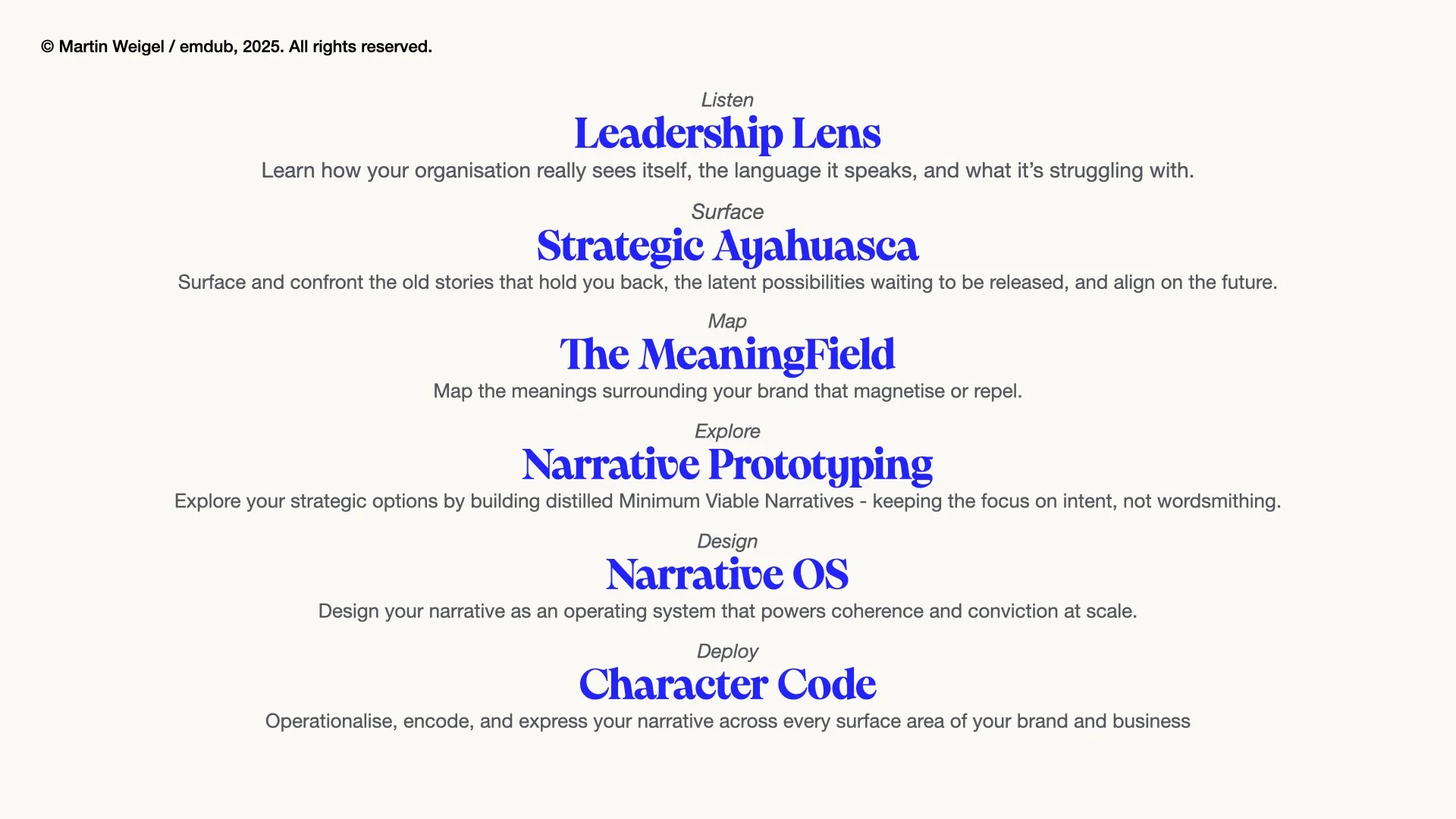
I know I’ve railed plenty of times here against stultifying process and the imaginative tourniquet of paint by numbers template culture. But the development of strategy is not the same as the necessary packaging up and selling-in of strategy. That remains my position. But the fact is that even when we embrace the gift of liberated creative (in its broadest sense) thinking, we do still have repeated problems to solve, repeated challenges to overcome, repeated outcomes required, repeated transformations sought, and we do still have repeatable approaches.
At the end of the day, client organisations aren’t showing up to buy “the work, the work, the work”, but the outcomes, the outcomes, the outcomes. Particularly when, as Michael Farmer has noted, brand growth today is increasingly hard to find. But how do we measure outcomes when results aren’t always visible, when attribution is unclear, analysis is arduous, or client data is limited (or there is no access to it), I know some will be asking. The mistake is assuming one needs perfect proof of impact; what is really needed is shared alignment on what success looks like. The smartest move is, I’ve found, to define that success together with the client at the outset - not just in terms of outputs, but in terms of meaningful indicators of progress. These can include classic lagging metrics like revenue, but more often they’re leading signals such as stronger internal alignment, faster time to market, better engagement, tighter coherence across functions, channels and touchpoints, or greater confidence to act. The goal isn’t to take credit for outcomes you can’t fully control, but to make a clear, logical connection between one’s work and the client’s forward movement. That’s why I’ve preceded engagements with an in-depth understanding of the scope of value before proposing and executing a scope of work.
I’m glad I took so much of the year to get properly ready to win. That preparation sees me closing the working year delivering a strategic narrative for a leading tech innovator preparing itself for the next era of growth. One that wraps itself around who they are and what they (will) do - designed to re-energise their people, shape every surface of the business (not just comms), and make them more powerfully competitive.
***
A different way of being in the world
The great American choreographer Twyla Tharp had some rather wise words on those pivotal, transformational moments in one’s life: “You have to be willing to find other ways of being in the world beyond those that have served you well throughout your life”. But to find other ways of being in the world, requires some acts of destruction.
In Hindu tradition, Shiva - known as the “Destroyer” - forms part of the divine trinity with Brahma, the creator, and Vishnu, the preserver. Yet Shiva’s destruction is not wanton or chaotic; it represents the vital act of making room for what is to come. Rather than being a force of ruin, Shiva embodies transformation - ending one cycle so another may begin. In this cosmology, destruction is not seen as negative, but as an essential stage in the ongoing rhythm of creation, preservation, and renewal. I’ve had to destroy a lot of myself this year.

In an agency, the scaffolding of process, hierarchy, and shared responsibility gave me a comforting sense of (relative) order. As an independent, that scaffolding no longer exists. You become the structure. I’ve had to destroy any fantasies of structure and safety, and learn to step into uncertainty without panic.
Agencies are orchestras - ‘the work’ is a collectively-owned endeavour with the fingerprints of many hands on it. As a soloist, however, that buffer evaporates. Your work, good or bad, is unmistakably and unavoidably yours. The loss of reflected status also removes the shield it provides. Agency walls protect you from full visibility, and if you’re lucky (as I have been), the agency name confers a certain reputation and authority. Step outside that structure and your name, your face, your beliefs, your judgement and your ability to add value become the brand. I’ve had to embrace the destruction of anonymous contribution, shed the protection of collective logos, let go of any residual attachment to scale or prestige, and accept full authorship, carrying the work and its consequences in my own name.
***
Shift happens
So much for destruction. But in the process I am transforming my role and value and dare I say it, the source of my (professional) self-worth.
It’s been instructive to experience what happens when the development and delivery of strategy is no longer seen as simply a precursor to or salesperson for advertising assets. More than just being useful to getting to ‘the work’, you’re an advisor to an organisation. The emotional and political context (and complexity) you’re operating in scales very rapidly, but so too does the access you’re granted. This year as part of a bigger project, I ran the Leadership Lens discovery process for a major client, and interviewed the entire global C-suite, every functional leader, every global business unit leader, and the principal country CEOs. It’s at that level of proximity that strategy I learnt, stops being an abstraction and starts to take on real weight.
What also changes (if you’re coming from the agency side of things) is that you’re also no longer the all-knowing expert. When you are agency-side you’re an expert (at least in theory) in communications, and are expected to be so. But when you’re developing solutions that promise to fundamentally shape an entire organisation not just its communications, you’re working with a whole range of internal (and often formidable) functional experts. You cannot be and are not expected to be The Expert riding to everybody’s rescue on the proverbial strategic white horse. You’re no longer The Owner of the solution - that’s for you to shape in collaboration with client. What you are expected to deliver is diagnosis, truth, counsel, options, and a choice-aiding framework.
Many years ago, Jim Carroll, self-described “long-serving strategist” and former Chairman of BBH wrote: “I am increasingly of the view that Clients don’t come to us for medicine; they come to us for therapy. And I suspect that our value resides, not as strategic doctors, but as strategic psychoanalysts. Often a successful modern Client engagement is not unlike a session of analysis. Clients begin with problems. They verbalise their thoughts, they make free associations, they express their fantasies and dreams. We listen, we interpret, we consider the unconscious conflicts that are causing their problems. We help them reach solutions through a process of self realisation.”
More and more I find myself acting as a counsellor and interpreter - helping leaders make sense of what they already know but haven’t yet named or faced, translating belief into decisions, and turning a new narrative into a lived logic that shapes choices, priorities, and actions. It's an ancient lesson – humility is the bedrock of service.
***
This state of independence shall be*
It turns out that the destruction of safety, scale, and anonymity doesn’t diminish the strategist’s role - it concentrates it. What independence has really changed is not my working life, but the quality of truth I can now bring into the room. With no creative agenda to serve (or pander to), no campaign or comms system to sell or protect, no production pipeline to feed, I’m free to sit with what’s actually going on - politically, emotionally, structurally - and voice the things that are usually postponed, denied, or softened. Free from the shackles of domestication, independence renders the strategist newly dangerous. It sharpens the work rather than shrinking it. It creates the conditions for candour, for holding the long view when organisations are under short-term pressure, and for no longer being obliged to only ever turn business and organisational issues into advertising-shaped problems demanding advertising-shaped solutions.
* Credit: Donna
***
Journey without maps
Hey, it’s early days. I’ve just taken the first step on a journey to who knows where. But I’ve begun to appreciate that sometimes what feels like fear is simply badly labeled excitement.
***
Ay-eye, ay-eye
I continued to believe that pretty much everybody is guessing wildly as to its lasting benefits. I continued to have many deep-seated qualms about its longer-term effects and second-order consequences. I continued to find it wearying to have to police its incessant lying. And I continued to refuse to use it for writing. Strategy after all, is first made manifest through words, not fingerpainting and as Yann LeCun has acknowledged, large language models work on a simple logic: they are trained on vast amounts of text to predict the most likely next word, then repeat that process continuously, feeding each prediction back into the system to generate the next. This rolling next-word prediction is the core mechanism on which LLMs are built. So when more than 190 million people use LLMs every day for ideas, they’re all being nudged toward the same gravity well. But f**k me, my strategic department of custom GPTs turbocharged the grunt, discovery, and pattern recognition work like nobody’s business.
***
Keeping things spicy
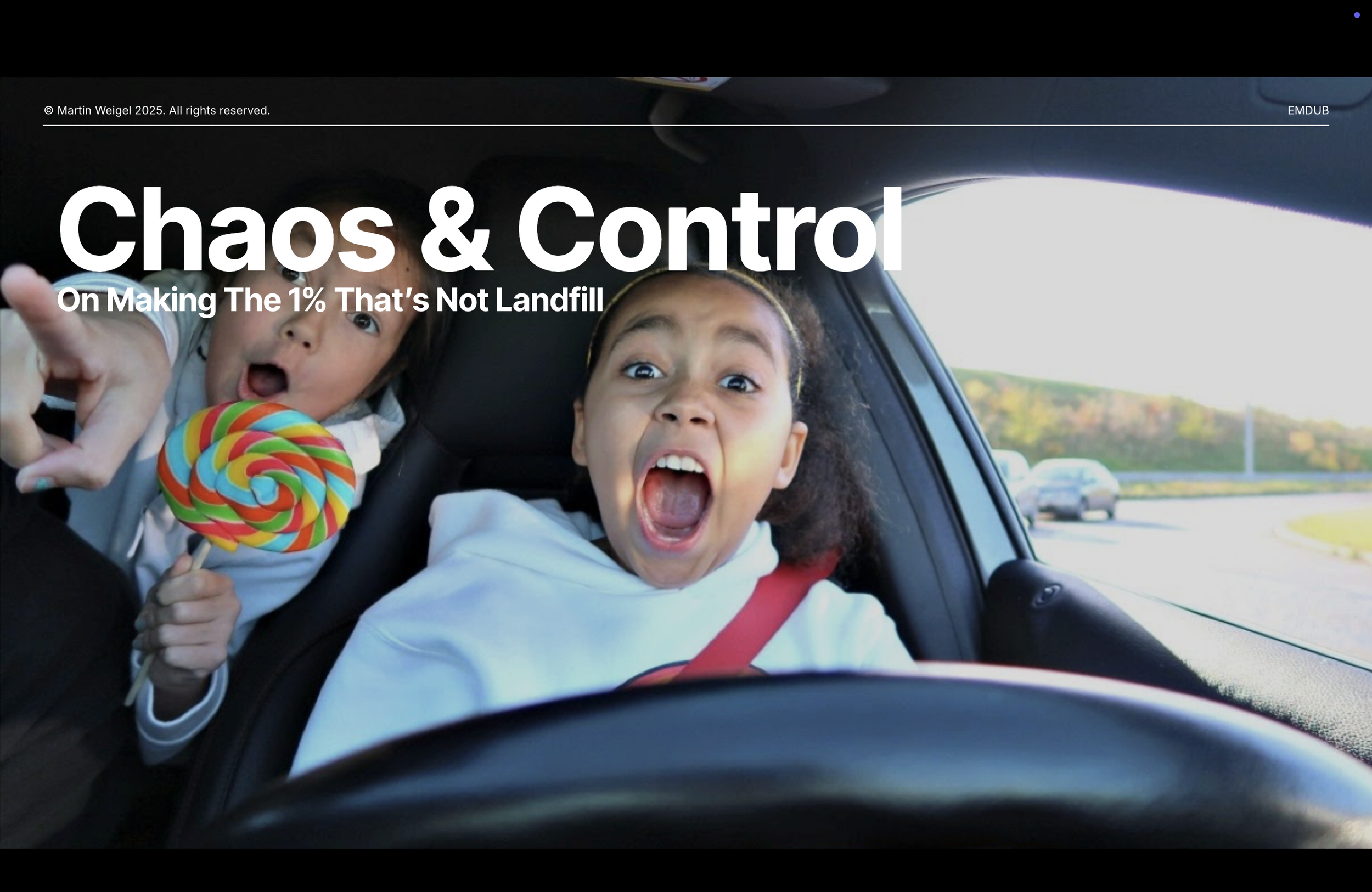
At the invitation of my friends at Leo Burnett Australia, I presented on the art and necessity of balancing (since both are vital conditions) making space for chaos and exercising control in the pursuit of creative ideas.
I talked about the pursuit of anti-kinda and pursuing one’s ‘very’ with my product design and innovation friends at Lululemon.
For the tenth year in a row, I was invited to contribute to Hoala’s Brand Strategy Master Course, and talked about the essential and enduring nature of strategy (because lord knows there’s not much real strategy being produced these days days).
The worst part was opening the Hoala programme knowing that mega-luminaries like Rob Campbell and Lucy Jameson would presenting after me. I found comfort in telling myself I was just the warm-up act. The best part of the experience were the one-on-one follow up sessions with participants, and having to field so many smart and unexpected questions. My thanks to Agustín Soriano and the Hoala team for indulging me year after year.
***
The agony and ecstasy
After many, many years of haunting me, I finally got it out of my system and delivered a manuscript (for me, it’s not a ‘book’ until it’s out in the world) on the practise of strategy, and the nature of the strategic mind. Hint: Frank Sinatra got it right when he sang - “Do be do be do”.
Juggling the day job with a year of wringing 60,000 words from myself was far from the romantic endeavour writing is so often portrayed as in the movies. In between the moments of flow, enthusiasm, and conviction was doubt, drudgery, the reluctant killing of favourite sentences (and chapters) and what sometimes felt like never-ending wholesale rewriting. I give thanks to my editor for keeping my eyes on the prize. Working with her has been truly an education in structure, coherence, voice, product-market fit, and attention to pixel-level detail.
I’m in the final stretch of tweaks before it goes off for typesetting and design, and hope to set it free in the world in Q.1 of next year. I’m not sure I care (that much) whether it sells, or even whether it’s widely read, because as someone once said, in bringing something new into the world, we often uncover new possibilities within ourselves. It’s been a clarifying experience for me, and I feel it’s prepared me for the second half of this game called strategy.
***
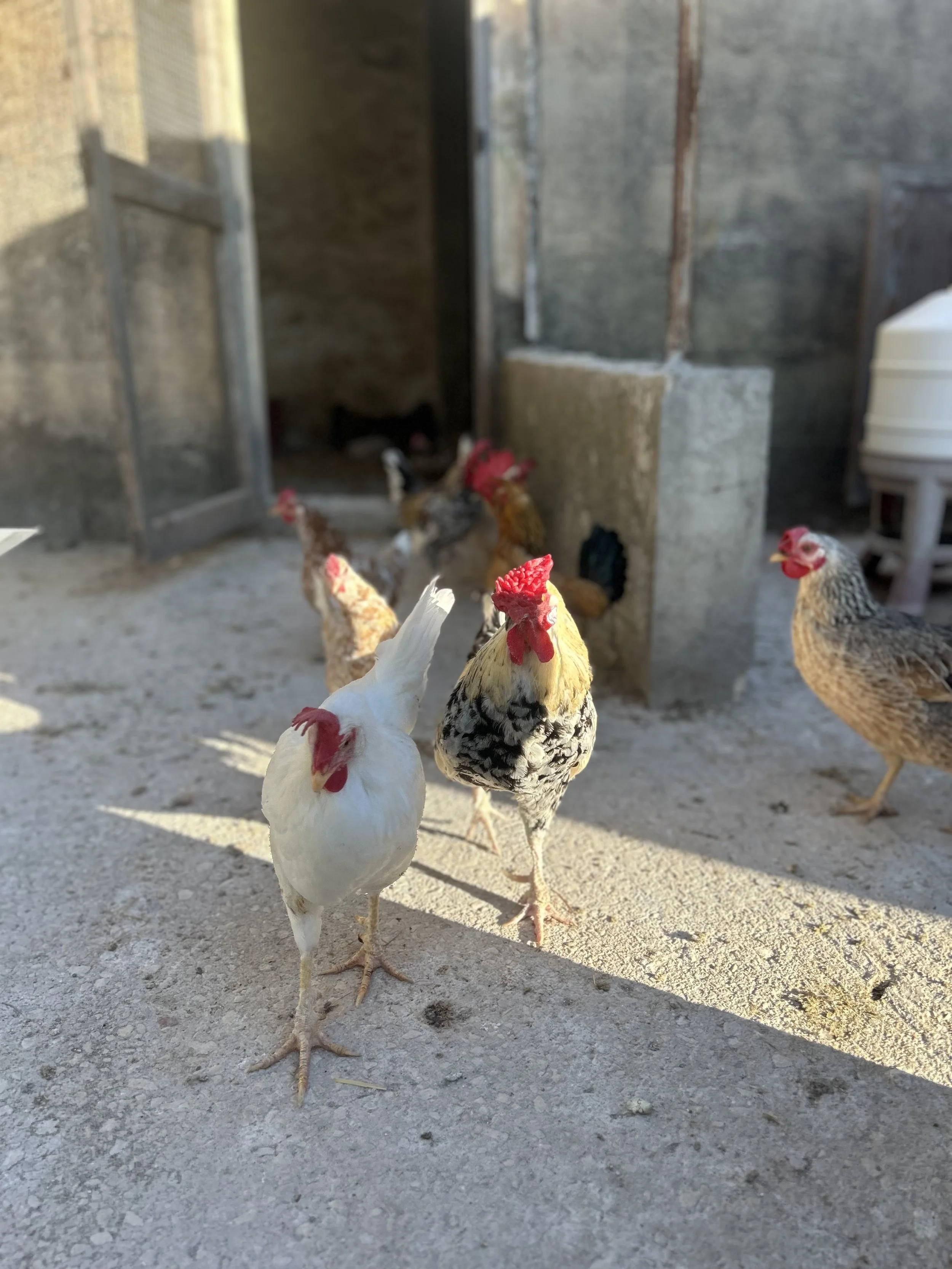
Along the way I learnt about rearing chickens and growing lemons. But that’s for another time. Perhaps. But for now at least, I really can’t be bothered to cosplay at LinkedIn Thought Leader and talk about what rearing chickens and growing lemons teach us about strategy.
***
Ryan Boudinot’s weird, wonderful, and batshit crazy dystopian novel Blueprints of the Afterlife is set in a future recovering from the "age of fucked up shit". This year certainly felt like we were living through that age of FUS, yet for me the practice of strategy continued to be the gift that keeps on giving. I found myself still having the time of my professional life, and I wasn’t yet tempted to jack it all in and re-qualify as a hairdresser. I count myself lucky.
Business leaders want truth, not complicity. They are acutely aware that they’re operating in a messy, non-linear world and do not see the trends and dynamics of yesteryear playing out like a neat straight line into the future. The basic principles of marketing and brand building might not change, but they also understand that, to borrow the words of John Rendon, former senior communications consultant to the White House and Department of Defense, the past as a solution set is not and cannot be the only viable option. They are hungry for an honest, outside perspective uncluttered by vested interest. From somebody who doesn't want to be right, but just wants them to win. Next year will be about expansion, putting these principles to work with more clients ready to do it on purpose.
***
I hope you too had blessings to count. And if you have been, thank you for reading.

Martin Weigel is a brand strategist, former Chief Strategy Officer at Wieden+Kennedy Amsterdam, and founder of EMDUB. He helps companies find their superpower - and turn it into action.